



Virtual CISO Services: 8 Must-Have Components to Look For
Abstract
Virtual CISO services give organizations access to senior cybersecurity leadership without hiring a full-time executive. They help guide security strategy, governance, compliance, risk management, remediation, incident readiness, and executive decision-making through an outsourced or fractional engagement.
This article explains:
- The core capabilities a strong virtual CISO service should include
- How advisory-only models differ from team-based execution support
- What to expect from remediation, incident response, and compliance readiness
- How executive reporting and governance support continuous improvement
- What to ask before choosing a virtual CISO provider
Virtual CISO services can range from light advisory support to a more structured security leadership model. The title alone tells you little about the support your organization will receive. If your organization is facing customer questionnaires, audit pressure, CMMC readiness, or board-level questions about cyber risk, you need to know exactly what the engagement will deliver.
Many internal teams are struggling to keep pace with growing cybersecurity demands. The World Economic Forum’s Global Risks Report 2026 ranks cyber insecurity as the sixth-most severe global risk over the next two years, reflecting concern about the increasing frequency and sophistication of attacks targeting businesses, governments, and critical infrastructure. Mid-market teams, therefore, need to account for capacity, not just expertise, when making a buying decision.
This article gives you a clear way to evaluate virtual CISO services before you choose a provider. The goal is to help you see which engagements match your internal capacity and provide the level of execution support you need.
What virtual CISO services should actually include
Virtual CISO services should help an organization translate cybersecurity risk into a working program. That usually includes support across strategy, governance, risk management, compliance support, remediation coordination, incident readiness, vendor risk oversight, and reporting.
Some vCISO engagements are advisory-heavy. In this model, a senior expert joins periodic calls where they review issues and give recommendations. That can work when the internal team has the capacity to execute on these recommendations.
Many mid-market organizations need a model with more execution support, including:
- Clear work prioritization
- Defined ownership
- MSP and internal IT coordination
- Evidence preparation for audits and customer reviews
- Leadership reporting
- Progress tracking
With this kind of service model, security work has a regular operating rhythm. Decisions are reviewed and open items are tracked. Specialists are available to step in when technical or compliance issues need more focused support.
What virtual CISO services should actually include
Virtual CISO services should help an organization translate cybersecurity risk into a working program. That usually includes support across strategy, governance, risk management, compliance support, remediation coordination, incident readiness, vendor risk oversight, and reporting.
Some vCISO engagements are advisory-heavy. In this model, a senior expert joins periodic calls where they review issues and give recommendations. That can work when the internal team has the capacity to execute on these recommendations.
Many mid-market organizations need a model with more execution support, including:
- Clear work prioritization
- Defined ownership
- MSP and internal IT coordination
- Evidence preparation for audits and customer reviews
- Leadership reporting
- Progress tracking
With this kind of service model, security work has a regular operating rhythm. Decisions are reviewed and open items are tracked. Specialists are available to step in when technical or compliance issues need more focused support.
8 must-have components of virtual CISO services
1. Security strategy and roadmap
A vCISO should help turn scattered security pressure into a roadmap. A practical risk management plan should connect identified risks to priorities, owners, remediation actions, timelines, and reporting expectations. The roadmap should also reflect the organization’s real operating context, including its exposure, outside requirements, upcoming deadlines, and internal capacity.
Look for a provider that can separate urgent exposure from longer-term maturity work. This gives leadership a clear sequence for improving the program without overwhelming the people responsible for the work.
2. Risk assessment and prioritization
Virtual CISO services should help the organization decide which risks deserve attention first. The vCISO should be weighing each issue in context:
- What does it affect?
- How exposed is the organization?
- What would it take to fix?
NIST CSF 2.0 can give that process a useful reference point because it connects cybersecurity work to governance and risk strategy. The provider should use NIST-informed practices to support risk decisions. They should not be promising that one engagement can “make you compliant.”
3. Governance, policies, and ownership
A vCISO should help clarify how security decisions get made inside the organization. That includes policy ownership, approval paths, security roles, review schedules, and escalation rules. A documented risk management policy can provide a consistent framework for assessing, approving, documenting, and reviewing those decisions across teams. Governance should make handoffs clear so security work does not drift between teams without an owner.
4. Compliance and audit readiness
A vCISO should help align the security program to the obligations that shape your organization’s security requirements. That may include SOC 2, ISO 27001, PCI, NIST-based requirements, CMMC, cyber insurance reviews, and customer security questionnaires. Effective compliance risk management connects those obligations to operational risks, named owners, controls, evidence requirements, and ongoing review. The provider should be clear about where it supports the process and where outside assessors, auditors, or certifying bodies take over. For example:
- For SOC 2 and ISO 27001, the vCISO can support readiness, evidence organization, control ownership, and audit preparation. Final attestation or certification remains with the auditor or certifying body.
- For CMMC, support should follow a defined readiness sequence. The provider may help the organization scope where controlled unclassified information is stored, processed, and transmitted; assess the applicable requirements; identify and prioritize gaps; manage permitted Plan of Action and Milestones activity within CMMC’s eligibility and scoring restrictions; organize supporting evidence; and prepare the organization’s designated Affirming Official for assessment, closeout, and ongoing affirmation obligations.
Buyers should also clarify what support for the NIST SP 800-171 DoD Assessment includes. Depending on the engagement, the provider may calculate the assessment score, review the evidence supporting each assessment objective, assist with recording the result and supporting summary information in the Supplier Performance Risk System, or coordinate all three. The scope should be documented rather than implied.
5. Hands-on remediation support
This is one of the clearest dividing lines between advisory support and a working vCISO service. Buyers should ask if the provider only identifies issues or also helps coordinate remediation.
Useful remediation support may include:
- Vulnerability management follow-up
- Control implementation planning
- Security awareness training
- Phishing simulations
- Vendor follow-up
- Evidence organization for audits and customer reviews
Because remediation often crosses lines between internal teams (IT, compliance owners, executives) and outside providers, a vCISO should help turn findings into assigned work instead of leaving each group to interpret next steps on its own.
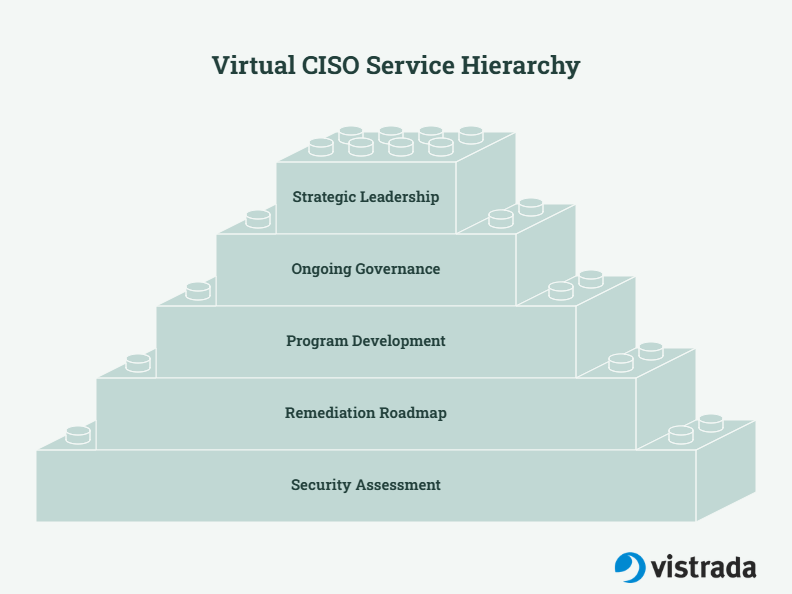
Vistrada's CISO as a Service offering is designed to move organizations from assessment into execution. Engagements typically begin with a security assessment to identify priority risks, followed by a practical remediation roadmap, program development, and ongoing governance to keep work moving.
A senior vCISO provides strategic leadership, executive guidance, and accountability for the overall program. Program management keeps actions, owners, deadlines, dependencies, and reporting on track. Specialists contribute focused services in areas such as compliance, risk management, policy development, incident response, vendor risk, vulnerability management, and continuity planning. Internal IT teams, MSPs, and other technical providers may remain responsible for implementing changes within systems and infrastructure.
Buyers should not assume that “hands-on support” means every activity is performed directly by the vCISO provider. Ask which activities the provider delivers, which it manages or coordinates, and which remain with the internal team, MSP, assessor, or another specialist. This distinction should be explicit for activities such as vulnerability scanning, phishing simulations, policy development, tabletop facilitation, evidence preparation, and technical control implementation.
6. Incident response and tabletop readiness
Incident response support should help the organization make faster, more coordinated decisions during a real event. A vCISO should define escalation paths, decision authority, executive communication procedures, and the roles of internal and external participants before an incident occurs.
That preparation should account for how executives, internal IT, the MSP, legal counsel, cyber insurance contacts, forensic specialists, communications teams, and other response partners will work together. Each party should know when they are brought in, what information they need, and who has authority to make operational, legal, financial, and public-communication decisions.
Tabletop exercises should produce more than a completed meeting. The provider should document gaps, assign corrective actions, validate decision authority, and update the incident response plan based on what the exercise reveals. Buyers should also confirm whether active incident support is included in the engagement, available on call, or separately scoped.
7. Executive reporting and continuous improvement
A vCISO should report on security posture, risk trends, open actions, compliance progress, control ownership, and investment priorities. The reporting should give executives enough context to make informed funding, prioritization, and risk acceptance decisions without translating technical detail themselves. This helps move security beyond technical oversight and into business accountability, where leaders share responsibility for enabling growth while managing risk.
Reporting should also drive continuous improvement. Each governance cycle should review trends in overdue findings, control performance, residual risk, remediation progress, and audit readiness. Those findings should inform the next roadmap update, budget discussion, remediation cycle, and set of program priorities.
Vistrada gives clients access not only to senior CISO leadership, but also to CIO and CTO expertise when security decisions affect technology strategy, operational priorities, infrastructure investment, or business transformation initiatives. This broader executive perspective is especially valuable as autonomous AI systems become part of business operations and create new agentic AI governance requirements.
Ask to see the dashboard or GRC reporting format before you buy. It should function as a recurring governance mechanism, not merely a presentation for leadership. The dashboard should show where exposure is increasing, where work has stalled, which controls are underperforming, and which decisions require executive action.
8. Vendor risk and third-party risk management
Mid-market companies often rely heavily on MSPs, SaaS platforms, contractors, subcontractors, and other outside providers. That creates exposure beyond the direct control of the internal team and makes third-party risk an ongoing governance responsibility rather than a one-time onboarding check.
Virtual CISO services should help:
- Identify and classify critical vendors and subcontractors
- Define security and evidence requirements
- Review supporting documentation
- Track remediation and recurring reassessments
- Establish a consistent vendor compliance process for collecting, reviewing, and refreshing documentation
- Document risk exceptions
- Escalate unresolved exposure to the appropriate executive
- Clarify who owns vendor- and supply-chain-related risk
This becomes particularly important for organizations handling controlled unclassified information, preparing for CMMC, or participating in the defense supply chain. A cyber supply chain risk management program should account for where sensitive information flows, which subcontractors may receive it, and whether contractual security obligations must flow down to those parties.
Oversight should continue after onboarding through continuous monitoring, evidence refreshes, remediation tracking, material-change reviews, and periodic reassessment. When a vendor cannot meet a requirement, the organization should have a defined process for accepting, mitigating, transferring, or escalating the risk.
How to spot a virtual CISO service that lacks follow-through
Some virtual CISO services look attractive because they promise senior expertise at a lower cost than hiring a full-time CISO. The weak point is often not the advisor’s expertise, but the gap between recommendations and finished work.
The same concern applies when the provider lacks a regular operating cadence or cannot show how open actions are owned and reported to leadership. Compliance support should be tailored to your regulatory obligations, business environment, audit deadlines, risk profile, and internal resources. Buyers should ask how the provider will adapt its recommendations, scope, and deliverables to those conditions rather than relying on broadly applicable framework guidance.
A static findings list is another concern. A provider may identify risks accurately, but the organization is left to determine ownership and execution on their own. Without coordination between MSP, IT team, compliance lead, executives, and security specialists, recommendations can sit untouched for months.
A vCISO should not leave your team with better-documented problems and no path forward. The engagement should create momentum by prioritizing the work, assigning accountability, tracking remediation, escalating stalled items, and giving leadership a clear view of progress.
How to evaluate a virtual CISO provider before you buy
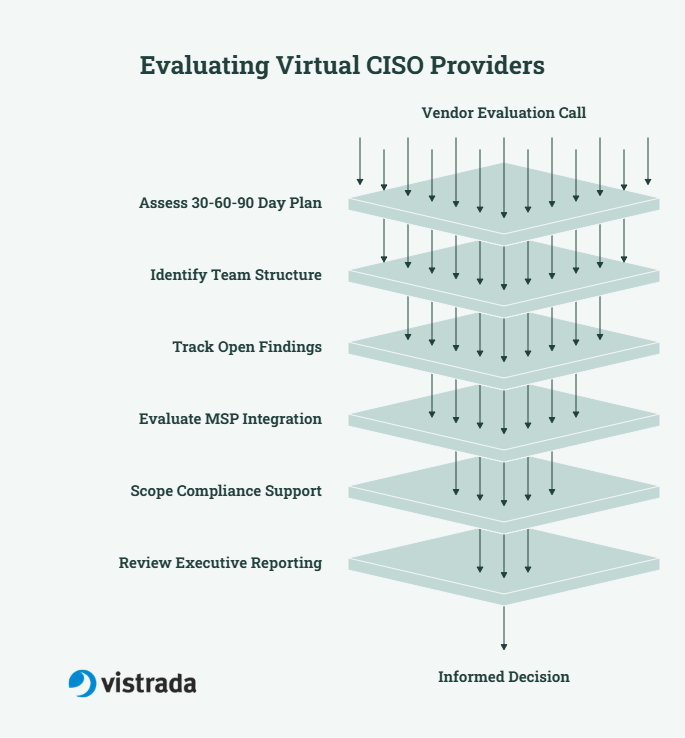
Use the vendor evaluation call to test how the service works after the first assessment. Strong providers should be able to explain their operating model in concrete terms:
- Ask what happens in the first 30, 60, and 90 days. You should hear how they assess risk, build the roadmap, set cadence, and identify quick wins.
- Ask who performs the work. If the service centers on one advisor, ask what happens when the work requires technical remediation, compliance mapping, vendor review, incident response planning, executive reporting, or technology leadership. If the provider uses a team model, ask who leads the engagement, which specialists participate, how they are assigned, and how work progresses between governance meetings.
- Ask how open findings are tracked. Recommendations should become assigned actions with owners, due dates, status updates, and leadership visibility. This question quickly identifies advisory-only services.
- Ask how the provider works with your MSP or internal IT team. A vCISO should create a clear division between strategic oversight and day-to-day implementation.
- Ask how compliance support is scoped. The answer should connect to your obligations, such as SOC 2, ISO 27001, PCI, CMMC, customer questionnaires, or cyber insurance. Generic framework language is not enough.
- Ask what executives will see. Reporting should support budget decisions, risk acceptance, audit preparation, and program improvement. If the reporting is too technical or too vague, leadership will not use it.
For organizations that need more than occasional advisory support, Vistrada's model combines dedicated vCISO leadership with a multidisciplinary team that expands as engagement needs evolve. A senior vCISO leads governance, executive communication, and strategic direction, while specialists provide hands-on support for compliance, remediation, vendor risk, policy development, and technical initiatives.
Formal monthly sessions give leaders a recurring opportunity to review risk, remediation progress, compliance priorities, investment needs, and decisions that require executive input. Between those sessions, the team tracks open actions, works with internal teams and MSP partners, brings in specialists where needed, and escalates blockers before they sit unresolved for another reporting cycle. That cadence helps reduce stalled work and keeps the security program moving between executive meetings.
Choose the vCISO partner that can move the program forward
Virtual CISO services should give your organization more than senior advice. The right provider helps you prioritize work, define ownership, prepare for audits, strengthen incident readiness, manage third-party risk, and report progress in language executives can use.
Vistrada's team-based model is built around that progression. It combines strategic CISO leadership with specialist execution and broader technology expertise so organizations can keep security initiatives moving without needing to build a large internal security function.
Talk to Vistrada about building a virtual CISO program that connects the threads of strategy, governance, remediation, and reporting. Book your vCISO briefing for your next 90-day plan.