

AI TRiSM (Artificial Intelligence Trust, Risk, and Security Management) is a governance framework that supports AI model accountability, trustworthiness, fairness, reliability, robustness, efficacy, and data protection across the AI lifecycle.
Furthermore, AI TRiSM connects AI use to the compliance and security programs already in place rather than treating it as a separate concern. For lean security teams, that means moving from general awareness to a program that assigns ownership, documents controls, and produces evidence when the business is asked how AI risk is managed.
Introduction
Most organizations did not plan to have an AI governance problem. They planned to use a few AI tools. Then those tools multiplied, vendors added AI features quietly, and employees started making business decisions with outputs no one had reviewed or approved. AI adoption moved faster than oversight, and the gap between what organizations are using and what they actually govern has become one of today's more consequential security and compliance risks.
88% of organizations now report regular AI use in at least one business function, yet many still lack the governance infrastructure to manage what that means for audit readiness, regulatory compliance, or executive reporting. That gap is precisely what the AI TRiSM (Artificial Intelligence Trust, Risk and Security Management) framework is designed to close. It gives organizations a structured approach to managing AI risk across governance, data protection, vendor oversight, and accountability. Here are ten steps to successfully implement AI TRiSM in your organization.
AI TRiSM: What is it, and why does it matter now?
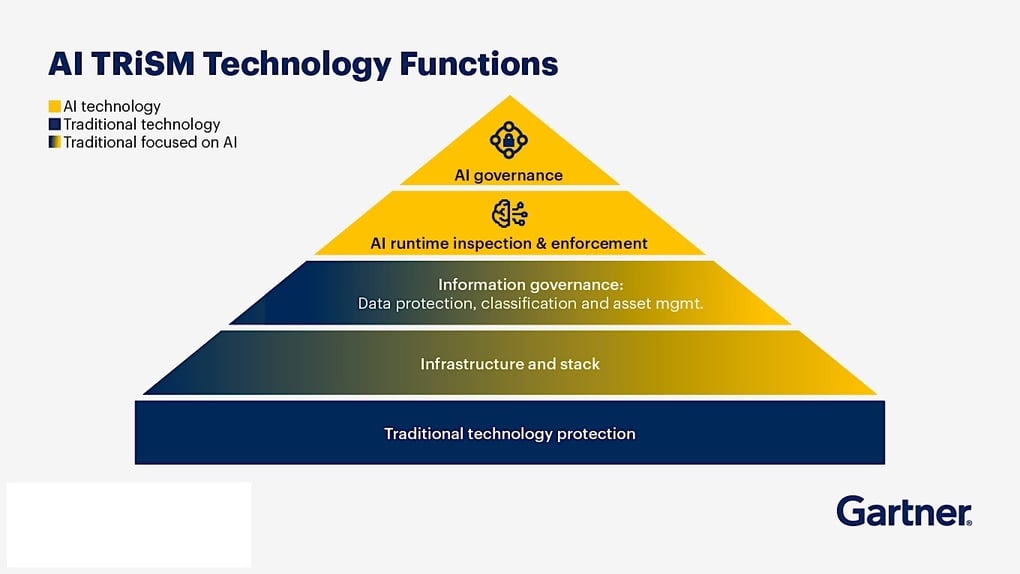
AI TRiSM, or AI trust, risk, and security management, is a Gartner-originated framework for governing AI once it becomes part of your business operations. Its purpose is to help organizations use AI with more confidence by making the systems behind it more trustworthy, reliable, and secure.
The framework became necessary because AI is no longer confined to controlled pilots or technical teams. It now shows up in the tools people already use, the vendors they already rely on, and the decisions they already make. That creates a governance problem: the organization may be accountable for AI-driven outcomes without having reviewed the system, the data, or the risk.
AI TRiSM gives organizations a way to bring that risk under control. It brings AI into the same governance discipline used for security and compliance, so the organization can define who owns the risk, how controls work, and what evidence supports them.
Key Benefits of AI TRiSM
For organizations using AI faster than they can govern it, AI TRiSM provides many benefits, including:
- Clearer Accountability – Defined ownership makes it clear who approves AI use, who monitors risk, and how exceptions or gaps are escalated.
- Stronger Data Protection – Sensitive data rules become easier to enforce when approved tools, prohibited uses, and handling requirements are documented up front.
- Better Audit and Compliance Readiness – The framework creates documentation and control evidence that can support audits, customer reviews, cyber-insurance requests, and compliance programs.
- More Reliable AI Use – Testing, limits, and human review help ensure higher-risk AI outputs are evaluated before they influence business decisions.
- Reduced Third-party AI Risk – Vendor AI becomes part of procurement and due diligence, including how data is used, retained, logged, and protected contractually.
AI TRiSM: Principles and Practices
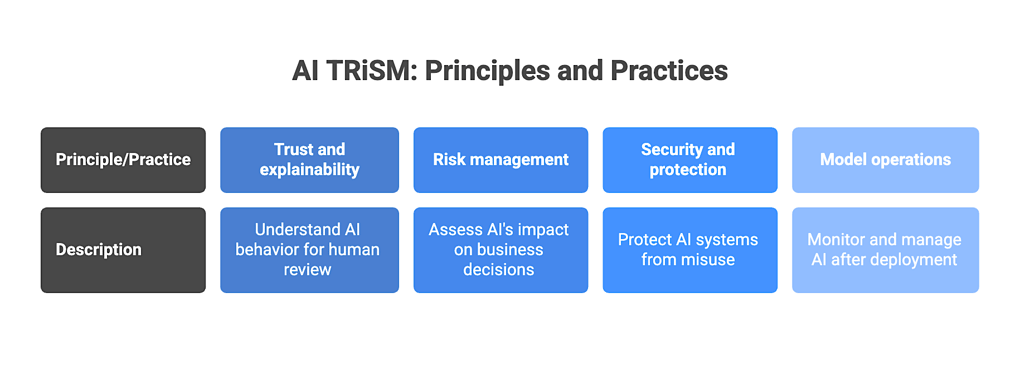
AI TRiSM principles and practices are the recurring disciplines an organization uses to make AI safe enough to trust and controlled enough to govern. They center on four areas:
- Trust and explainability address whether AI behavior can be understood well enough to support human review, oversight, and accountability. The goal is not perfect transparency, but enough clarity to evaluate how the system is being used and where its limits are.
- Risk management addresses how AI could affect business decisions, compliance obligations, and operational outcomes. It helps the organization determine where AI risk is acceptable and where stronger governance is required.
- Security and protection address the AI-specific controls needed to protect data, applications, and models from exposure, misuse, or adversarial manipulation.
- Model operations address how AI systems are monitored and managed after deployment, so the organization can catch changes in behavior before they affect the business.
Together, these disciplines give organizations a practical way to evaluate whether AI can be trusted in the role it is being asked to play.
10 Steps to Implement AI TRiSM
Use these ten steps to implement AI TRiSM in your organization successfully:
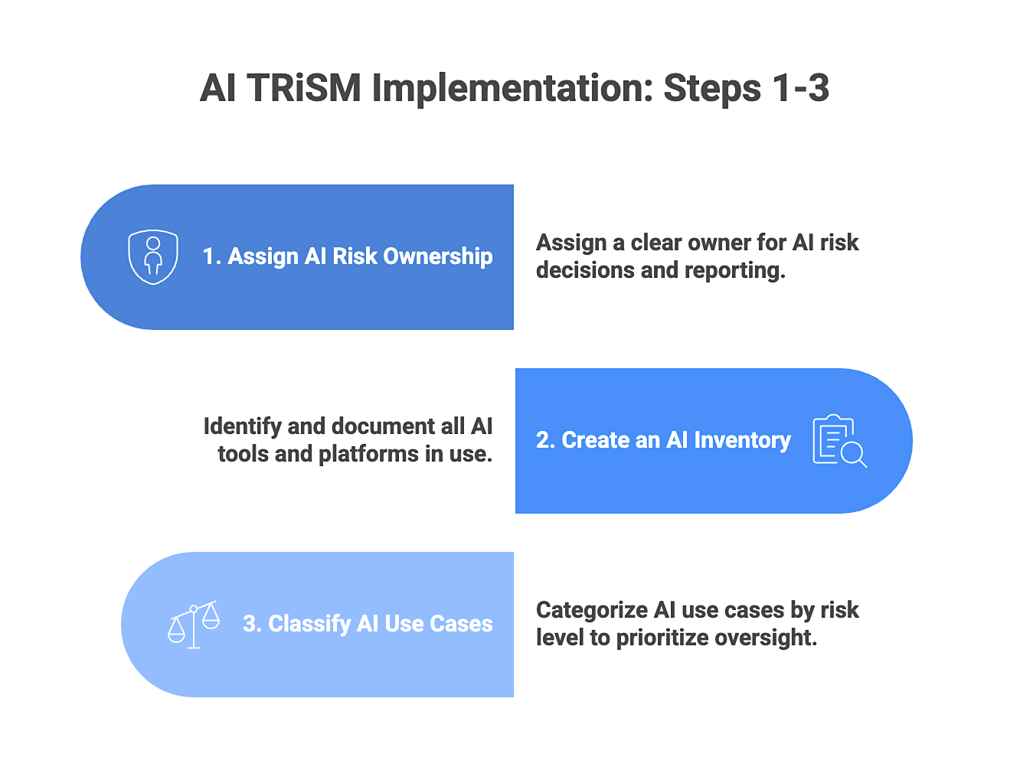
Step 1: Assign AI Risk Ownership
AI governance fails when responsibility is distributed without accountability. Without a named owner, AI risk decisions can stall, and reporting may never reach the people who can act on it. Ownership needs to be explicit, and include an executive sponsor, defined functional responsibilities, and a clear line into the security governance process already in place.
How to Implement:
- Name an executive owner with authority over AI risk decisions and exceptions
- Define functional responsibilities across security, IT, compliance, legal, and procurement
- Establish an approval process for new AI use cases before they go into production
- Connect AI risk reporting to the vCISO, GRC function, or existing security governance structure
- Set a cadence for AI risk review at the leadership level
Step 2: Create an AI Inventory
Most organizations underestimate how much AI they are already using. SaaS platforms add AI features in routine updates, employees adopt tools independently, and vendors embed AI into services without making it obvious. A complete inventory provides the foundation to make smart governance decisions based on complete information.
How to Implement:
- Identify all AI infrastructure and tools, features, integrations, APIs, and vendor platforms in use across the organization, including capabilities embedded in existing SaaS tools
- For each item, capture critical information: the business owner, user base, data types involved, vendor, integrations, access level, and approval status
- Flag unapproved tools for review and remediation
- Establish a process to keep the inventory current as tools are added, updated, or retired
Step 3: Classify AI Use Cases by Risk
Not every AI tool carries the same risk, and a one-size governance approach wastes resources on low-risk tools while leaving high-risk use cases under-managed. A risk tiering system gives the organization a rational basis for allocating oversight, setting control requirements, and prioritizing reviews.
How to Implement:
- Define risk tiers:
- Low | Productivity tools with no sensitive data
- Moderate | Business workflows with some data exposure
- High | Tools that touch CUI, regulated data, customer decisions, contracts, or security operations
- Rate each use case in the inventory against the defined tiers. Use data sensitivity, business impact, regulatory exposure, automation level, and vendor involvement as the primary factors.
- Require human review before outputs from high-risk tools influence business decisions
- Revisit tier assignments when tools, use cases, or data flows change
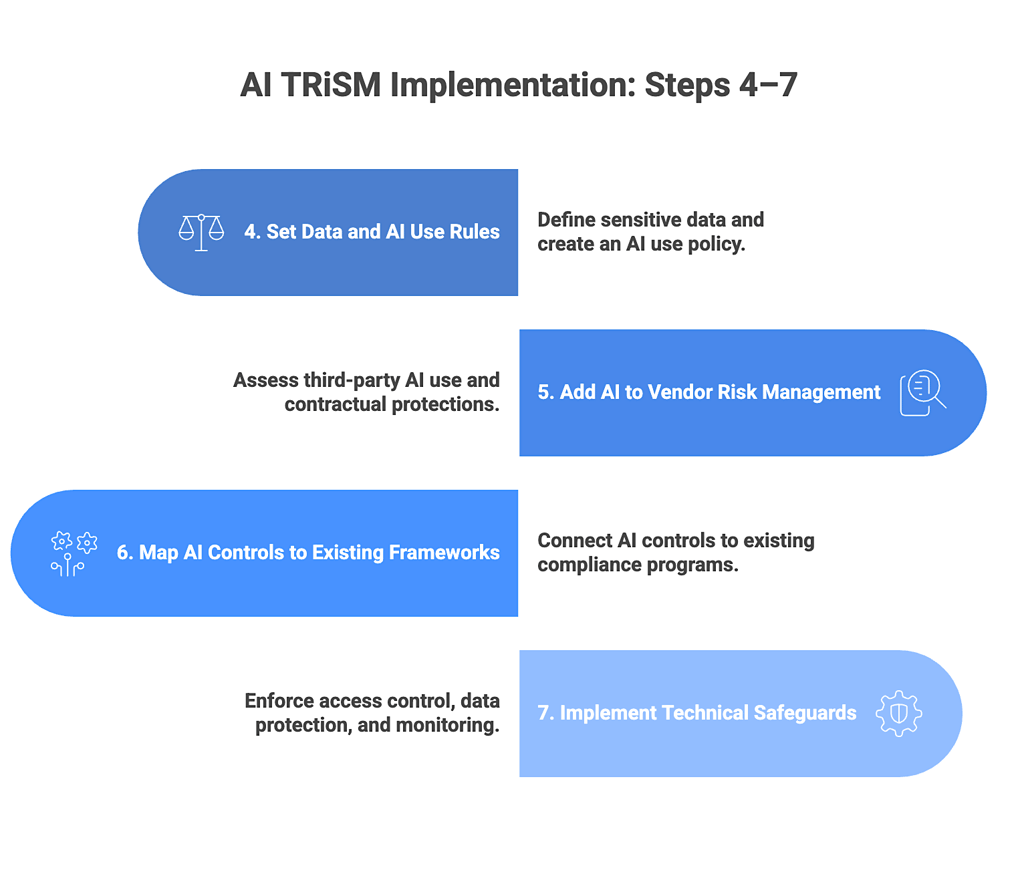
Step 4: Set AI Use and Data Rules
Employees make data handling decisions every time they use an AI tool, often without realizing it. For AI TRiSM to work, the organization needs clear data rules that define what information is sensitive, regulated, confidential, or approved for AI-assisted work. Once those data rules are understood, the organization can create an AI use policy that tells employees how different types of data can be used in AI tools.
How to Implement:
- Classify sensitive data types before writing AI use rules:
- Define parameters:
- Establish a process for requesting exceptions and document approvals
- Communicate the policies to all staff and include it in onboarding
Step 5: Add AI to Vendor Risk Management
Third-party AI is where most organizations carry their greatest unexamined exposure. Vendors and SaaS platforms may use AI in ways that affect how customer data is processed, retained, or used to train models. The due diligence questions that apply to any vendor risk apply here with additional specificity.
How to Implement:
- Add AI-specific questions to risk engineer vendor assessments: Does the vendor use customer data to train AI models? How long are prompts and outputs retained? Can the customer opt out?
- Review available audit logs and confirm contractual protections are in place
- Assess whether vendor AI use is consistent with your data classification and handling requirements
- Apply this review to existing vendors during the next assessment cycle, not only to new tools
- Document findings and flag gaps for remediation or contract renegotiation
Step 6: Map AI Controls to Existing Frameworks
AI governance that runs as a separate track creates duplication, inconsistent evidence, and blind spots in existing compliance programs. Mapping AI controls to the frameworks already in use connects AI risk to the review cycles, audit evidence, and reporting structures that already exist.
Different frameworks and obligations apply for different reasons, so AI controls should be mapped according to the program, data, and systems involved:
|
Framework/Obligation Area |
How It Relates to AI TRiSM |
|
ISO 27001 |
Provides the information security management foundation for AI governance controls. |
|
ISO/IEC 42001 |
Addresses AI-specific management system requirements. |
|
Provides a structure for managing AI risk across governance, mapping, measurement, and ongoing management. |
|
|
NIST SP 800-171 |
Connects AI controls to CUI protection requirements when CUI is involved. |
|
SOC 2 |
Supports evidence for security, availability, confidentiality, processing integrity, or privacy controls tied to AI use. |
|
CMMC, CUI, and SPRS |
Apply most directly in defense contractor environments where AI tools may process, store, or expose FCI or CUI. In this context, SPRS scoring reflects NIST SP 800-171 assessment results. |
|
PCI |
Matters when AI tools touch cardholder data or systems in the PCI scope. |
How to Implement:
- Map AI controls to the frameworks and obligations already governing your organization, aligning them to existing control categories such as access management, data protection, vendor risk, incident response, and executive reporting
- Flag AI-related gaps in existing framework assessments and route them through the standard remediation process
- Ensure CMMC, CUI, and SPRS obligations are handled distinctly from other framework requirements
- Capture AI control documentation using existing audit evidence workflows
Step 7: Implement Technical Safeguards
Technical safeguards are the controls that make AI TRiSM enforceable at the system level. They help protect approved AI use through access control, data protection, monitoring, and AI-specific security measures. Every organization needs a baseline set of safeguards, with stronger controls where AI use creates higher risk.
Those stronger controls are most important when AI tools connect through APIs, handle sensitive data, or could be manipulated through prompts. For lean teams that rely on internal IT or MSP support, Vistrada’s team-based vCISO model helps translate those requirements into prioritized controls, implementation coordination, and the documentation needed for governance and reporting.
How to Implement:
- Enforce an approved AI tool allow-list at the network or endpoint level
- Require SSO, MFA, and role-based access for approved AI platforms
- Configure DLP rules to flag or block sensitive data moving toward unapproved destinations
- Deliver security awareness training that specifically addresses AI risk and the use policy
Step 8: Test AI Systems for Trust, Reliability, and Security
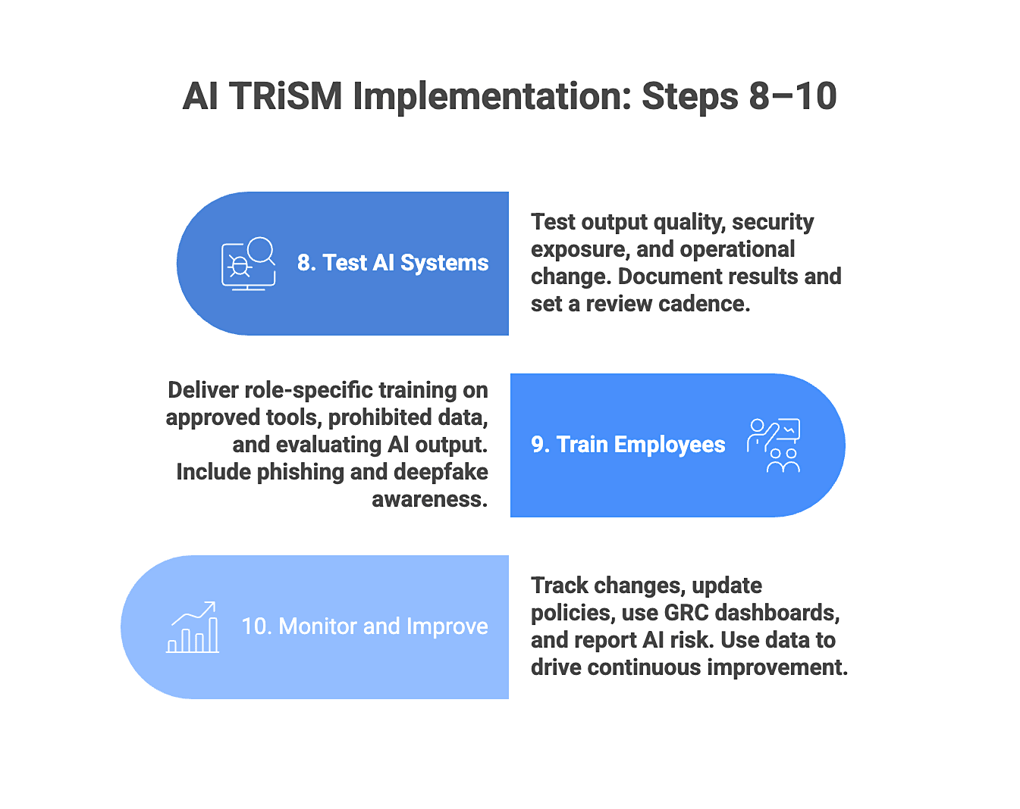
AI testing should continue for as long as the system is in use. Before an AI tool supports a business process, the organization should test whether the output is reliable and the controls are working. Ongoing monitoring helps confirm the system remains within approved boundaries as its use changes. For AI used in consequential workflows, testing is part of normal oversight rather than a one-time review.
How to Implement:
- Test output quality before deployment, including accuracy, bias, hallucination risk, and whether results stay within the system’s documented scope.
- Test for security exposure: can the system be manipulated through adversarial inputs, unauthorized access, prompt injection, or data leakage?
- Establish monitoring for operational change: when model behavior shifts through vendor updates or drift, ensure changes are detected and reviewed
- Document test results and set a review cadence for live systems, particularly those used in higher-risk workflows
Step 9: Train Employees and Business Owners
AI TRiSM depends on people knowing what they are allowed to do with AI tools. Training should explain which tools are approved, what data cannot be used, when AI outputs need review, and how to raise questions before risky use becomes normal practice. Role-based training is essential because different teams make different decisions about AI use and need guidance that fits their responsibilities.
How to Implement:
- Deliver role-specific training to employees, managers, developers, procurement teams, compliance leads, security teams, and executives. Training should cover approved tools, prohibited data types, requesting exceptions, reporting AI-related incidents, and how to evaluate AI output before acting on it.
- Include AI-assisted phishing and deepfake awareness as part of security training
- Establish clear accountability for leaders who sponsor AI use in their functions
Step 10: Monitor, Report, and Improve
AI TRiSM works best as an active program. As AI use expands, ongoing monitoring helps the organization keep policies, vendor reviews, control evidence, and leadership reporting aligned with how AI is actually being used. For lean security teams, sustaining that oversight is often the hard part. Vistrada’s team-based vCISO model helps keep AI risk connected to the broader security and compliance program, so reporting improves as the program matures.
How to Implement:
- Track vendor information on a defined review cycle, including inventory changes, policy exceptions, vendor updates, incidents, audit findings, and control gaps
- Update the AI use policy, vendor assessments, and risk tiers when significant changes occur.
- Use GRC dashboards to give leadership current visibility into AI risk posture
- Report AI risk through the same channels as other security and compliance risks
- Use audit findings and incident data to drive continuous improvement in the governance program
Bring AI TRiSM Into Your Risk Program
AI TRiSM gives organizations a structured way to manage AI risk before it turns into something harder to fix. These ten implementation steps help bring your organization's AI use into the security and compliance programs already in place.
Vistrada helps organizations operationalize AI TRiSM through the full program lifecycle. It starts with team-based vCISO leadership to establish ownership and reporting structures, and risk assessment to identify and classify what AI is actually in use.
Vistrada supports policy development, vendor review, control mapping, and hands-on program execution to align AI governance with the compliance frameworks already in place. GRC reporting and ongoing program support keep governance current as your team’s AI use grows.
Contact Vistrada about adding AI TRiSM controls to your vCISO, GRC, and cybersecurity risk program.