

Has your organization ever been close to winning a contract when a compliance review asks who has access to Controlled Unclassified Information (CUI), and the answer is not clear? A single overlooked security risk can create compliance failures that slow approvals and disrupt contracting outcomes. When this happens, stakeholders judge your organization on the risks you identified and those you failed to act on. In those moments, the absence of a defensible risk assessment becomes a significant liability.
Industry data confirms this reality, with 59% of organizations citing regulation and compliance as the primary drivers for risk reduction. A security risk assessment provides a structured way to understand where you are truly exposed, and shifts security conversations from technical issues to business-level risk. A well-run assessment clarifies which risks matter most and why they require action, which allows leadership to make informed decisions before an incident occurs.
Executing security risk assessments well requires consistency, rigor, and sustained follow-through. However, many organizations lack the dedicated leadership to maintain that discipline alongside day-to-day security and technology demands. As a result, they often stall after documentation instead of driving remediation and continuous improvement. Understanding the essential components of a security risk assessment is the first step toward closing that gap.
What is a security risk assessment?
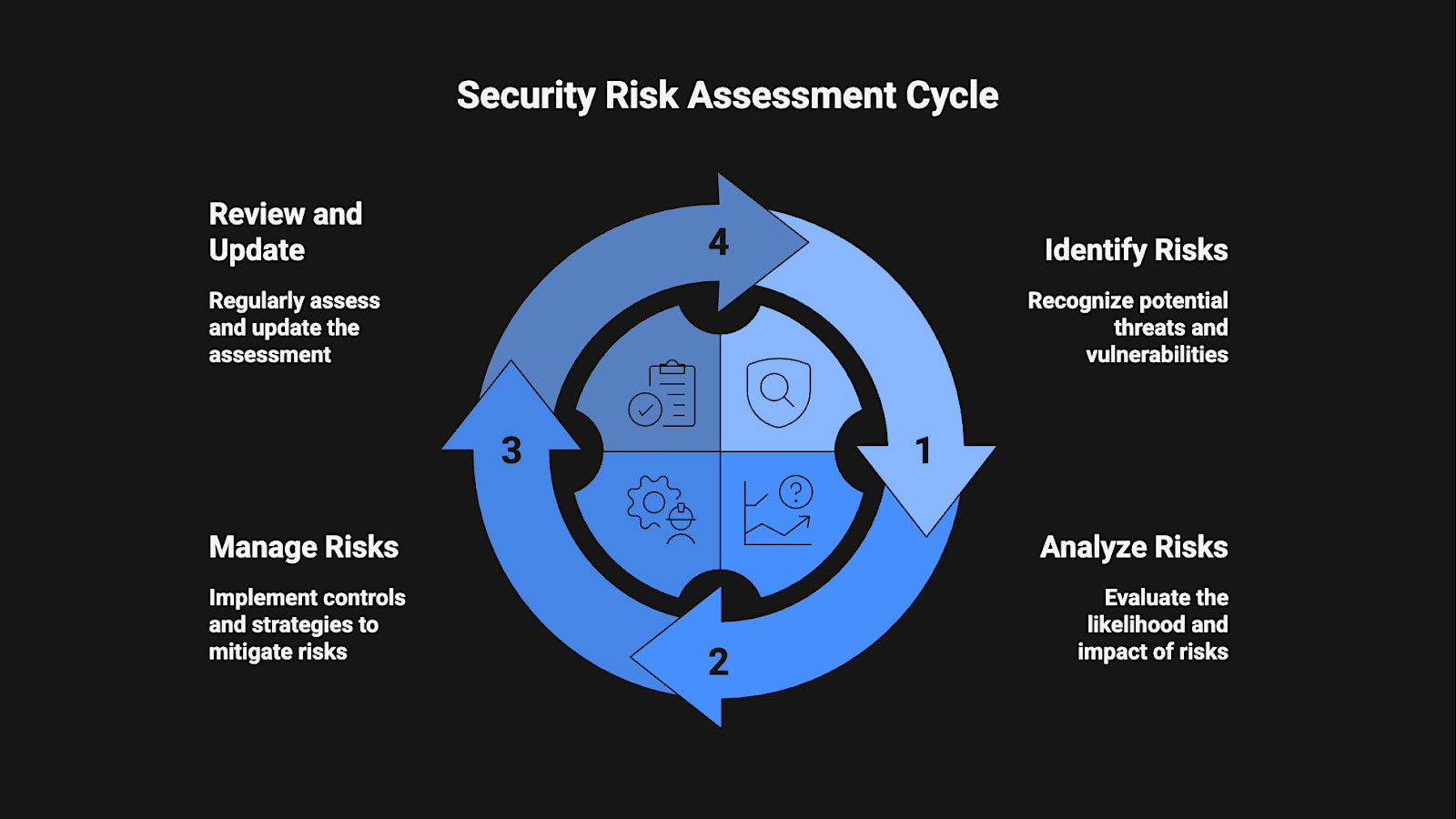
A security risk assessment is the process used to identify, analyze, and manage cybersecurity and information security risks across critical systems, data, and digital operations. It determines how specific threats or control gaps translate into business risk. The resulting data provides a consistent view of security posture that leadership teams use to support governance decisions.
These assessments are commonly used by organizations that must protect critical assets or meet regulatory mandates. While typically led by CISOs or risk teams, the process often includes executive oversight to ensure alignment with business goals. Many organizations use external advisors or vCISO services to provide the necessary leadership and expertise for the evaluation.
Security risk assessments are essential because they provide a defensible basis for prioritizing remediation. They ensure that your security strategy manages the most credible threats to business continuity rather than reacting to technical issues in isolation. Without this data, an organization lacks the objective evidence required to justify security budgets or prove compliance during an audit.
How often should you perform a security risk assessment?
A baseline security risk assessment is typically performed annually to ensure your security posture remains aligned with your business objectives. However, a static annual schedule is often insufficient for dynamic environments. You should conduct additional assessments following significant changes to your infrastructure or business model, such as:
- Infrastructure Shifts: Cloud migrations, the deployment of new applications, or significant architectural redesigns.
- Corporate Transitions: Mergers, acquisitions, and divestitures that introduce new security risks.
- Supply Chain Changes: Vendor onboarding, periodic reassessment of critical vendors, or changes in third-party access levels that require focused vendor risk evaluation.
Assessment frequency also depends on how critical the assets involved are. High-risk systems should be assessed more frequently than low-risk assets to maintain proper oversight. The goal is to transition toward a model of continuous assessment that supports earlier identification of emerging security risks.
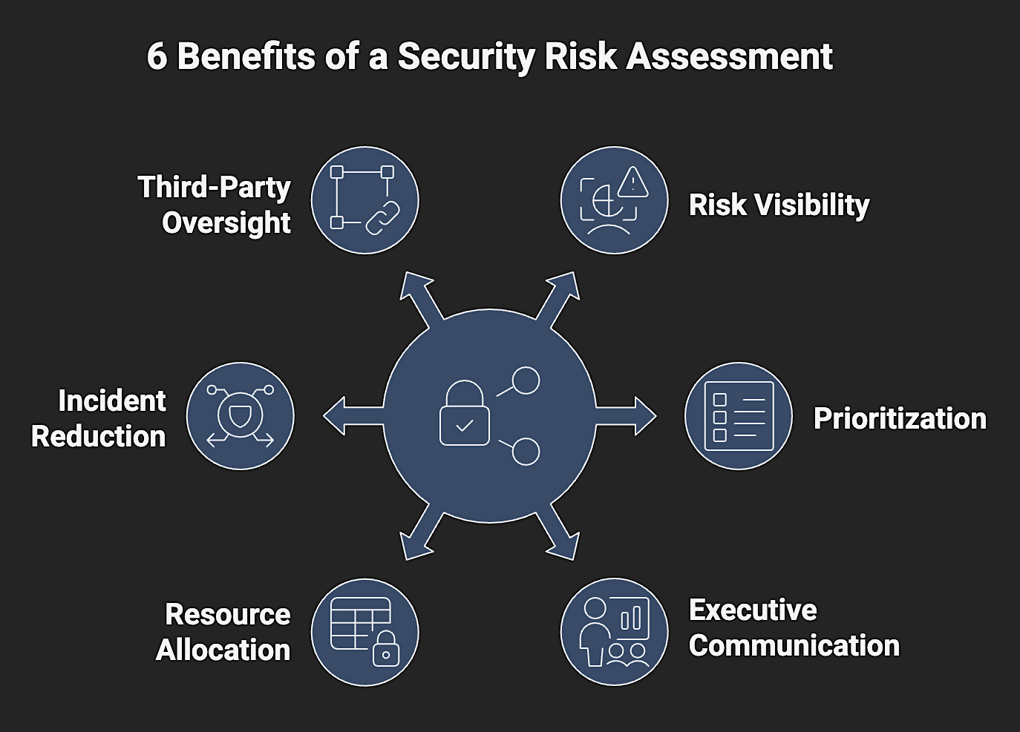
6 Benefits of a Security Risk Assessment
Implementing a rigorous assessment process provides several key benefits:
- Risk Visibility – Instead of managing isolated technical silos, you gain a consolidated view of cybersecurity risk across the entire organization.
- Prioritization Based on Business Impact – Ranking vulnerabilities according to their potential effect on operations ensures that your team addresses the most critical threats first.
- Defensible Executive Communication – The assessment process generates comparative and empirical data, like Compliance Percentages and Residual Risk Scores, that supports clear reporting to boards and leadership teams.
- Optimized Resource Allocation – Leadership can direct security budgets and remediation efforts toward areas that yield the highest risk reduction.
- Proactive Incident Reduction – Identifying and treating risk exposures early lowers both the likelihood and the potential impact of future security incidents.
- Comprehensive Third-Party Oversight – Integrating vendor and partner security evaluations into your overall security posture mitigates risks within your supply chain, including risks tied to third-party access.
What frameworks apply to a security risk assessment?
For your security risk assessment to be effective, it's crucial to have it guided by a cybersecurity and information security framework. These are the formal standards used to evaluate how well your organization protects its systems and data. Requirements vary by industry and contracts; organizations use both mandated requirements and voluntary frameworks to standardize assessment and reporting.
Here are the most common frameworks leveraged in a robust security risk assessment:
- NIST Risk Management Framework (RMF): Provides structured guidance for identifying, analyzing, and treating cybersecurity risk within the system development life cycle, often used in federal and high-assurance environments.
- NIST Cybersecurity Framework (CSF): Establishes a common language for organizing and communicating cybersecurity risk to both technical teams and executive leadership.
- ISO/IEC 27001: Defines the specific criteria for establishing and maintaining an information security management system (ISMS) effectively.
- ISO/IEC 27005: Provides dedicated guidance for performing information security risk assessments within programs already aligned with ISO requirements.
- CISA Risk Assessment Guidance: Practical recommendations designed to help organizations assess and manage cybersecurity risk through validated government standards.
- Industry and Regulatory Frameworks: Sector-specific mandates, such as CMMC for defense contractors or SOC 2 for service providers, that dictate the scope, documentation, and reporting requirements for your assessment.
8 Essential Components of a Security Risk Assessment
1. Risk Identification
Risk identification is the process of mapping specific threats to the vulnerabilities within your unique systems, data, and applications. It works by identifying the attack surface, the total sum of points where an unauthorized user can enter or extract data, and determining the methods an adversary would use to exploit those points. This critical step moves the assessment from a theoretical exercise to a factual inventory of the specific conditions that could lead to a breach, data loss, compliance failure, or system outage.
How to do it:
- Define the cybersecurity risk assessment boundaries by creating a scoped inventory of critical systems and data flows.
- Conduct stakeholder interviews, architecture reviews, and penetration testing to uncover logic flaws and vulnerabilities that automated scanners typically miss.
- Analyze historical incident data to identify recurring patterns or systemic weaknesses that have not yet been addressed.
- Map dependencies and data handoffs between internal environments and third-party partners to identify supply chain risks.
2. Risk Analysis
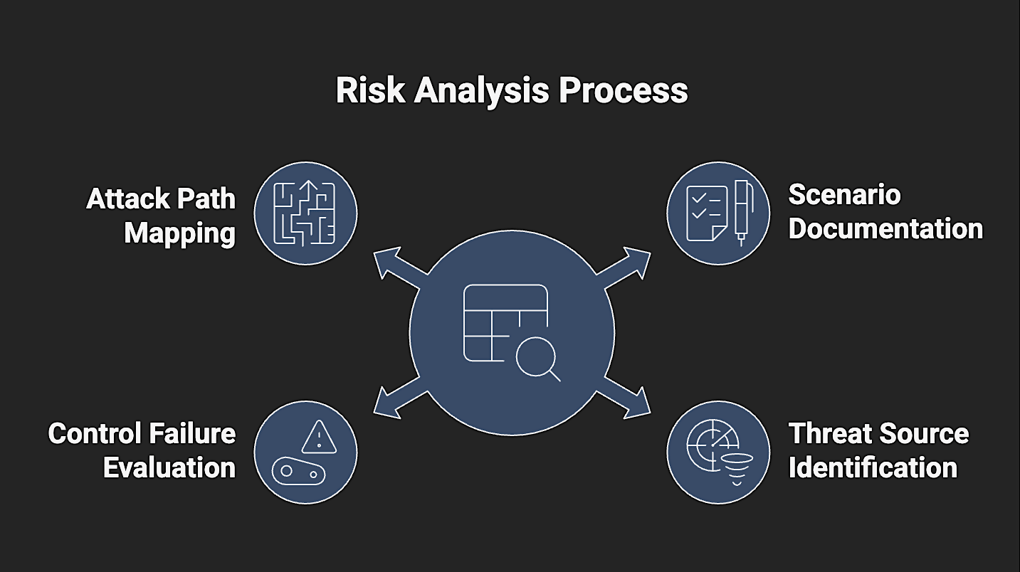
Risk analysis quantifies the likelihood and impact of identified threats by evaluating specific attack vectors against existing controls. It involves mapping the technical mechanics of an exploit, such as credential theft or SQL injection, to the value of the affected asset. This process generates the evidence used to determine which vulnerabilities represent a material risk to business operations and which are lower priority under the organization's likelihood-and-impact criteria.
How to do it:
- Document the specific scenario and technical preconditions required for each identified risk to manifest in your environment.
- Identify the likely threat sources and the particular business processes that would be disrupted if the risk were exploited.
- Define exactly which security controls or human processes would need to fail for the risk to result in a successful material breach.
- Evaluate the plausible attack paths an adversary would take to navigate from initial access to your high-value data or critical systems.
3. Risk Scoring
Risk scoring applies defined likelihood and impact criteria to each analyzed risk to produce a consistent value. This measurement transforms disparate technical findings into a structured data set that allows for direct comparison within the organization using the same rubric. Scoring is the mechanical basis for prioritization, enabling leadership to track risk trends and allocate resources based on the actual severity of threats to organizational stability.
How to do it:
- Utilize a likelihood and impact matrix with clearly written scoring definitions to ensure every evaluator is using the same baseline.
- Evaluate the probability of occurrence against the potential magnitude of financial, operational, and reputational damage.
- Conduct calibration sessions with key stakeholders to review scores and reduce individual bias or technical silos.
- Map scores to a risk heat map to provide a visual representation of the organization's overall risk posture.
4. Control Mapping
Control mapping aligns existing and planned security safeguards with specific identified risks to determine the actual mitigation coverage. It evaluates the technical and administrative controls in place to reveal where defensive posture is sufficient and where gaps persist. This cybersecurity risk assessment process identifies control gaps and limited compensating controls by exposing instances where a threat has no corresponding control or where a safeguard fails to reduce the risk in practice.
How to do it:
- List every relevant preventative and detective control for each identified risk, ensuring they are linked to specific technical or procedural assets.
- Document the individual control owners to establish accountability for the maintenance and performance of each safeguard.
- Collect and note evidence, such as configuration logs or audit results, to verify if controls are operating effectively rather than just existing in policy.
- Identify "orphan risks" that lack any mapped controls to highlight immediate areas for security investment or remediation.
5. Risk Prioritization
Risk prioritization ranks risks by their potential for material business disruption. It filters raw technical scores through specific business constraints: revenue impact, regulatory obligations, and system criticality. The resulting rankings ensure that resources are directed to the risks that matter most to the organization's continuity.
How to do it:
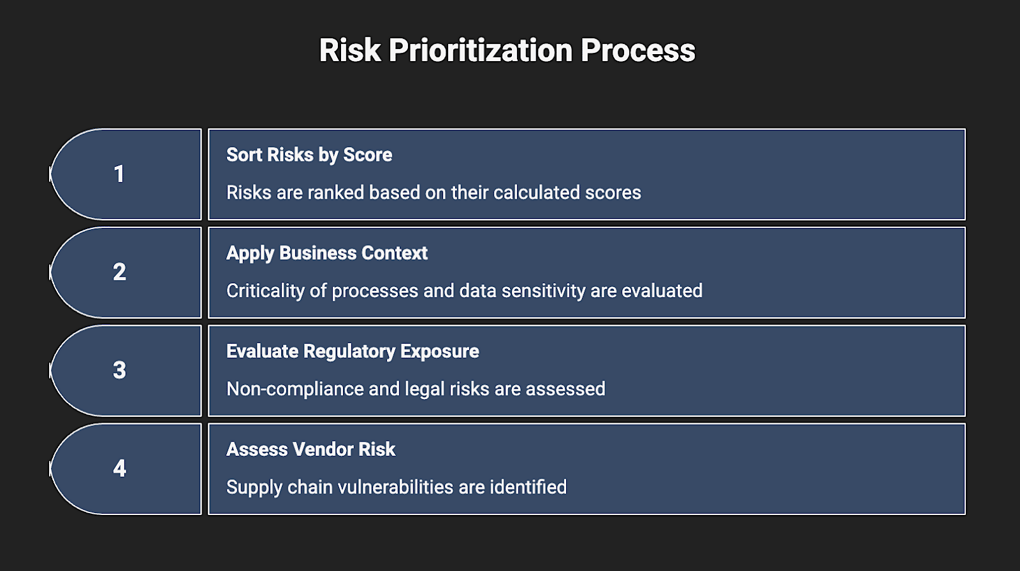
- Sort risks by their calculated scores to establish a baseline for remediation based on likelihood and impact.
- Apply business context to the raw scores by evaluating the criticality of the affected business processes and the sensitivity of the data involved.
- Evaluate regulatory and legal exposure to prioritize risks that could result in non-compliance, fines, or mandatory disclosures.
- Assess vendor and third-party concentration risk to identify if a single failure point in the supply chain elevates the priority of a specific vulnerability.
6. Remediation Planning
Remediation planning defines the specific technical and administrative actions required to bridge the gap between risk discovery and resolution. This phase transforms the assessment into a functional risk management plan by detailing the specific strategy, owners, timelines, and success criteria for every identified threat. Effective planning ensures that assessment data results in measurable risk reduction, preventing the final report from becoming a documented list of liabilities that the organization has failed to address.
How to do it:
- Select a formal risk treatment strategy (Mitigate, Transfer, Avoid, or Accept) for every identified risk to define the technical objective of the remediation.
- Define concrete, technical, or administrative actions for every top-tier risk identified in the prioritization phase.
- Assign a single accountable owner to each task to ensure that remediation responsibilities do not vanish into departmental silos.
- Establish firm due dates based on the risk level to ensure that the most critical vulnerabilities are addressed within an accelerated timeframe.
- Standardize the evidence required to confirm completion, such as a successful re-scan or a signed-off policy update, to prevent premature closure of risk items.
7. Ongoing Reassessment
Ongoing reassessment updates risk data as systems, vendors, and threat conditions change. This continuous feedback loop replaces static reports with updated risk data through defined reassessment triggers and regular review cycles, with tooling used where it speeds visibility. Eliminating point-in-time snapshots prevents decisions based on outdated assumptions and ensures the organization operates on technical realities.
How to do it:
- Establish formal cybersecurity risk reassessment triggers, such as significant architecture changes, onboarding high-access vendors, or introducing new data types.
- Reassess critical vendors on a defined cadence and whenever their access, data scope, or control environment changes.
- Monitor for material incidents or "near-misses" that indicate a specific risk profile has shifted and requires immediate re-evaluation.
- Conduct a review of all top-tier risks on a regular cadence, typically quarterly or biannually, to account for the evolving threat landscape.
- Update the central risk register to reflect mitigated threats or newly discovered gaps identified during the review cycle.
8. Reporting and Governance
Reporting and governance convert risk data into a decision-ready format that ensures accountability across the organization. This process transforms technical metrics into business intelligence, moving risk data out of technical silos and into the hands of executive leadership. Formalized governance provides the oversight required to ensure risks are actively owned, funded, and tracked as part of a permanent corporate strategy.
How to do it:
- Maintain a living risk register that tracks every identified threat alongside its assigned owner, current status, and the evidence of its mitigation.
- Present a recurring risk summary to the board or executive team that ties technical findings directly to business decisions and resource allocation.
- Establish clear escalation paths for risks that exceed the organization's defined risk appetite or fail to meet remediation deadlines.
- Utilize Vistrada's vCISO service to own this assessment cadence and align stakeholders on priorities, while providing governance leadership with an objective, expert-level view of the company's progress and remaining exposure.
Bridge the Gap between Assessment and Execution
Security risk assessments provide a structured, repeatable way to identify, evaluate, and manage cybersecurity and information security risk. Effective assessments connect technical security issues directly to business impact and decision-making. Treating this assessment as an ongoing process improves resilience as systems, vendors, and threat conditions change. However, many organizations lack a dedicated security leader to own this lifecycle, resulting in inconsistent execution and stalled remediation.
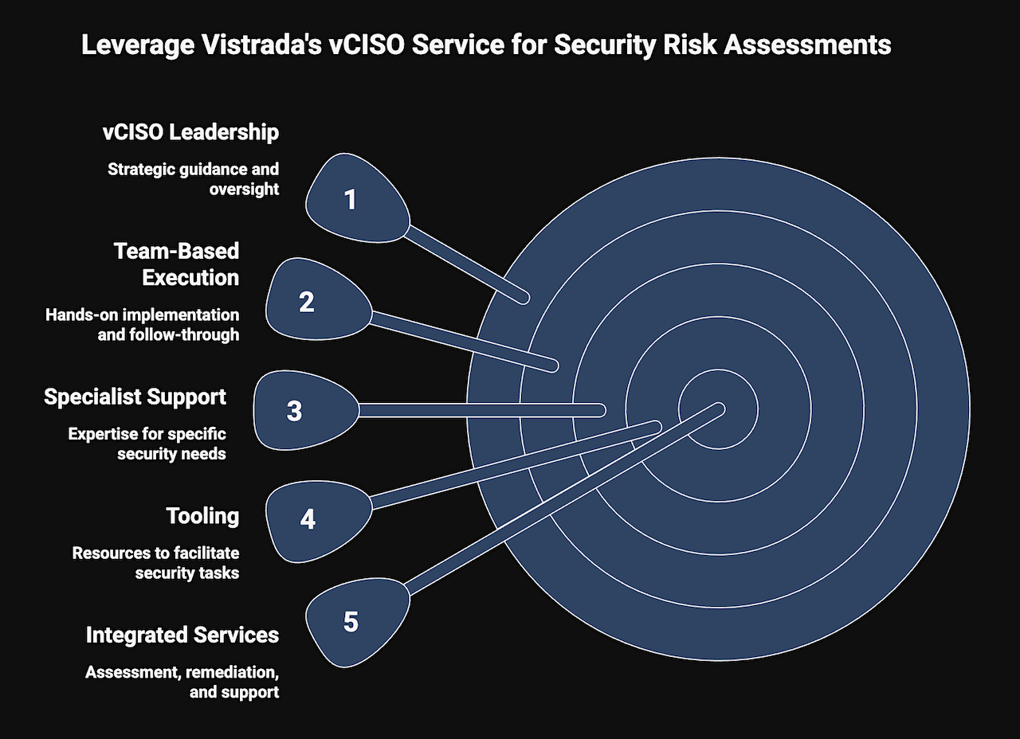
Vistrada delivers a high-touch, team-based vCISO service that goes beyond periodic advisory support. Unlike a typical fractional CISO model that relies on one person with limited quarterly involvement, Vistrada delivers a team-based operating rhythm designed for ongoing execution and follow-through.
Clients receive CISO leadership combined with hands-on execution from a broader team that includes CIO and CTO expertise, plus specialist support and tooling to carry work through to completion. These engagements integrate assessment, remediation, and ongoing support, including incident response, at a lower cost than full-time or fractional roles.
Contact Vistrada today to see how our vCISO services can bridge the gap between your security risk assessment and execution.