

Cybersecurity is a critical driver of business velocity. Billion-dollar organizations can’t afford to cozy up with your company if you put them at risk for an incident. For companies in the mid-market, the difference between closing a contract and losing it during due diligence often comes down to a single question of whether you can prove your data is secure. This trust is an essential currency for growth, especially when the impact of a breach is so high.
The average cost of a data breach is now north of $4.4 million, reaching almost double this for the highly regulated healthcare industry. Customers, partners, and regulators increasingly expect organizations to demonstrate formalized security controls. ISO 27001 is an international standard for information security management that carries significant weight in these negotiations.
ISO 27001 controls are widely referenced as a baseline for information security programs. CISOs are often asked to explain how their programs align with the standard, even when certification is not the immediate objective. If you can successfully implement ISO 27001 controls, you signal to your partners that you are operating a sophisticated security management system. Let’s explore the most critical ISO 27001 controls and how to implement them to create a defensible, audit-ready security program.
ISO 27001: What is it, and why is it important?
ISO/IEC 27001 is an international standard that sets the requirements for an Information Security Management System (ISMS). It defines a structured, risk-based framework for managing and improving information security across an organization. The standard applies across sectors and is widely recognized by customers and regulators.
The best part of ISO 27001 is that it is risk-based, not prescriptive. You need to identify your own unique security gaps and choose the most effective ways to close them. You are not forced towards a specific solution, allowing you to select tools and processes that align with your budget and business. A widely used governance framework among CISOs, ISO 27001 effectively guides risk decisions and ensures the company is ready for an audit. Certification demonstrates that the organization follows a structured and auditable approach to managing information security risk.
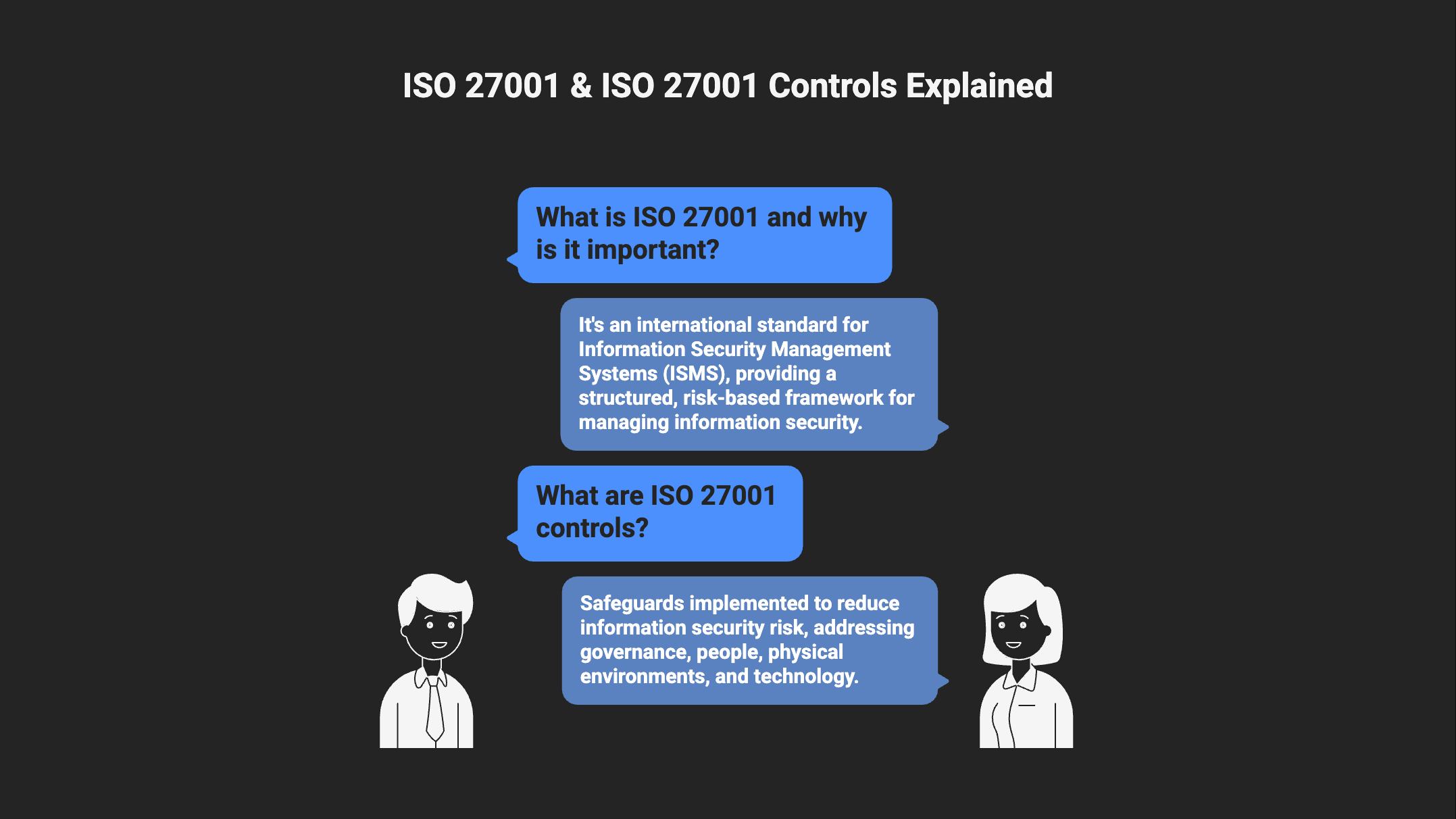
What are ISO 27001 controls?
An ISO 27001 control is a safeguard or countermeasure implemented to reduce information security risk. There are currently 93 controls listed in Annex A of the 2022 version of the standard that address governance, people, physical environments, and technology. Together, they translate risk assessments into enforceable governance and operational safeguards that can be evaluated during audits and security reviews.
Organizations implementing an ISMS under ISO 27001 select and justify applicable controls based on their documented information security risks. It’s important to note that there’s no pressure to use every control, but the organization must create a Statement of Applicability (SoA) that explains which controls you’ve chosen and why certain controls were left out.
Benefits of ISO 27001 Controls for CISOs
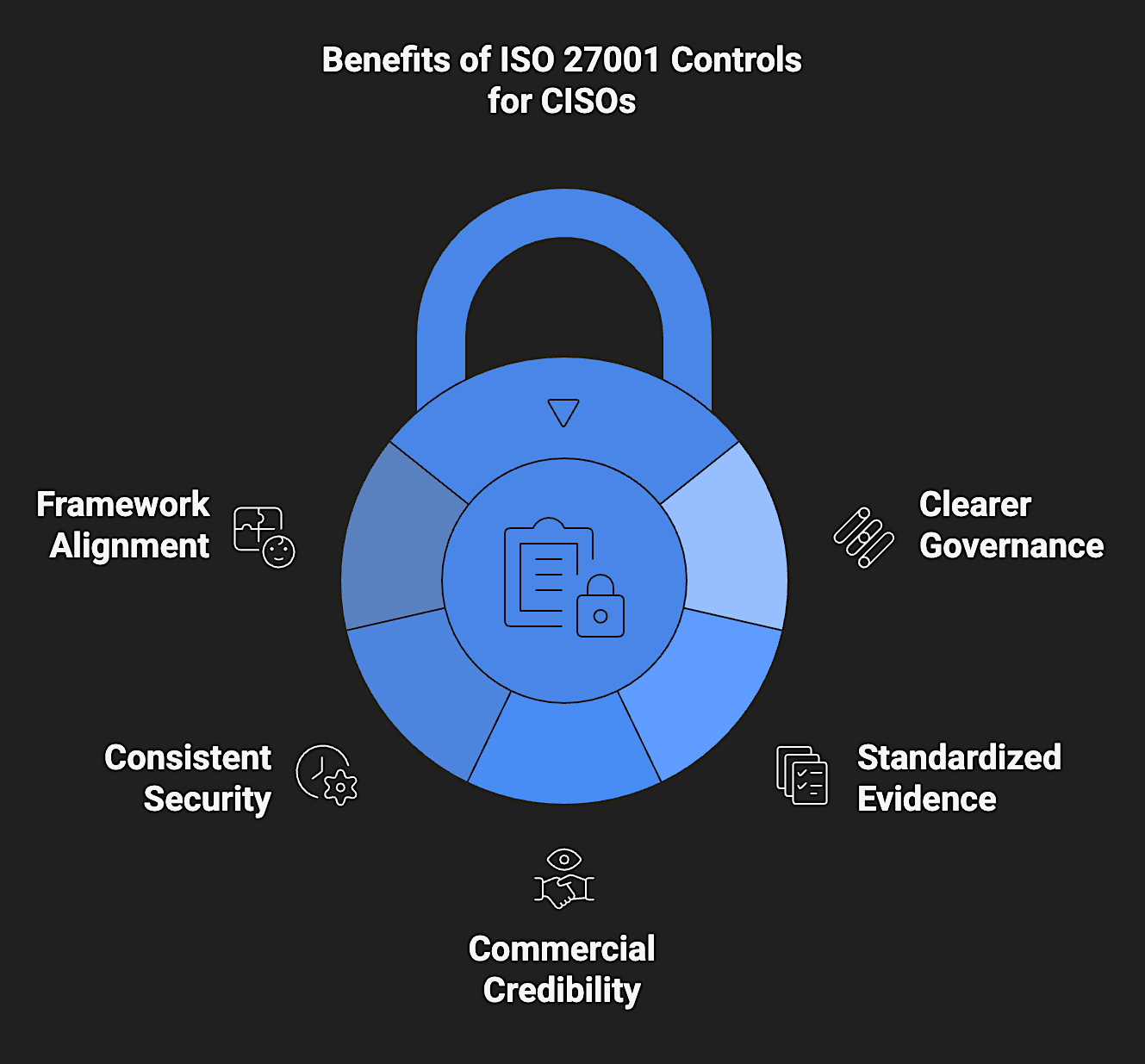
Implementing ISO 27001 controls offers many benefits, including:
- Clearer Governance and Accountability – ISO 27001 controls eliminate the gray areas between your internal team and your MSP. When specific owners are assigned, tasks don’t fall through the cracks, and leadership understands who is accountable for specific outcomes.
- Standardized Evidence Collection – ISO 27001 controls require you to maintain documented proof (called artifacts) of security activities. This documentation is already ready when auditors turn up.
- Commercial Credibility with Larger Enterprises – A clear financial boon, ISO 27001 helps mid-market companies gain larger clients. An uncertified vendor is a high risk for a billion-dollar organization to take on. An ISO certification shows that you are working on the same level when it comes to security enforcement.
- Consistent, Risk-based Security Practices – ISO 27001 controls require formal risk assessment and documented treatment decisions. It replaces ad hoc security decisions with a repeatable, risk-driven approach that can be applied consistently across the organization.
- Alignment Across Security and Compliance Frameworks – ISO 27001 controls align with many other common security frameworks. Organizations can build on existing controls rather than recreating them when pursuing additional certifications or responding to new regulatory requirements.
What are the four ISO 27001 control categories?
ISO 27001 controls cover four categories, grouped in a way that makes it easier for non-technical executives to understand security. Let’s break them down by focus and number of controls in each:
1. Organizational Controls (37)
Organizational controls define how information security is governed within the organization. You need to document how information is classified, how assets are tracked, and how third-party vendors are managed.
2. People Controls (8)
People controls address how personnel are managed in relation to information security. They address the lifecycle of an employee or contractor, from employment screening and onboarding to security awareness training, and eventually to offboarding.
3. Physical Controls (14)
Physical controls protect physical locations and assets that store or process information by securing the spaces where your people work and your data lives. In practice, this includes items such as access controls for restricted facilities, environmental protections for critical infrastructure, secure handling of off-site equipment, and physical safeguards for technology assets that interface with production systems or vital processes.
4. Technological Controls (34)
Technological controls protect systems and data through technical safeguards implemented across the IT environment. This category includes controls such as identity and access management, encryption, and vulnerability management.
ISO 27001: Main Clauses 4–10 (ISMS Requirements)
While Annex A lists the reference ISO 27001 controls used to treat risk, Clauses 4 through 10 define the mandatory requirements for governing the Information Security Management System. These clauses establish how risk is assessed and documented, which informs the selection and maintenance of ISO 27001 controls.
For example, if a risk assessment identifies the risk of unauthorized access to sensitive data, the organization may select ISO 27001 controls related to identity and access management from Annex A.
It’s important to understand that Annex A is a reference control set which is not mandatory in its entirety, but consideration of all its controls is compulsory. Organizations may implement controls not listed in Annex A.
Clause 4: Context of the Organization
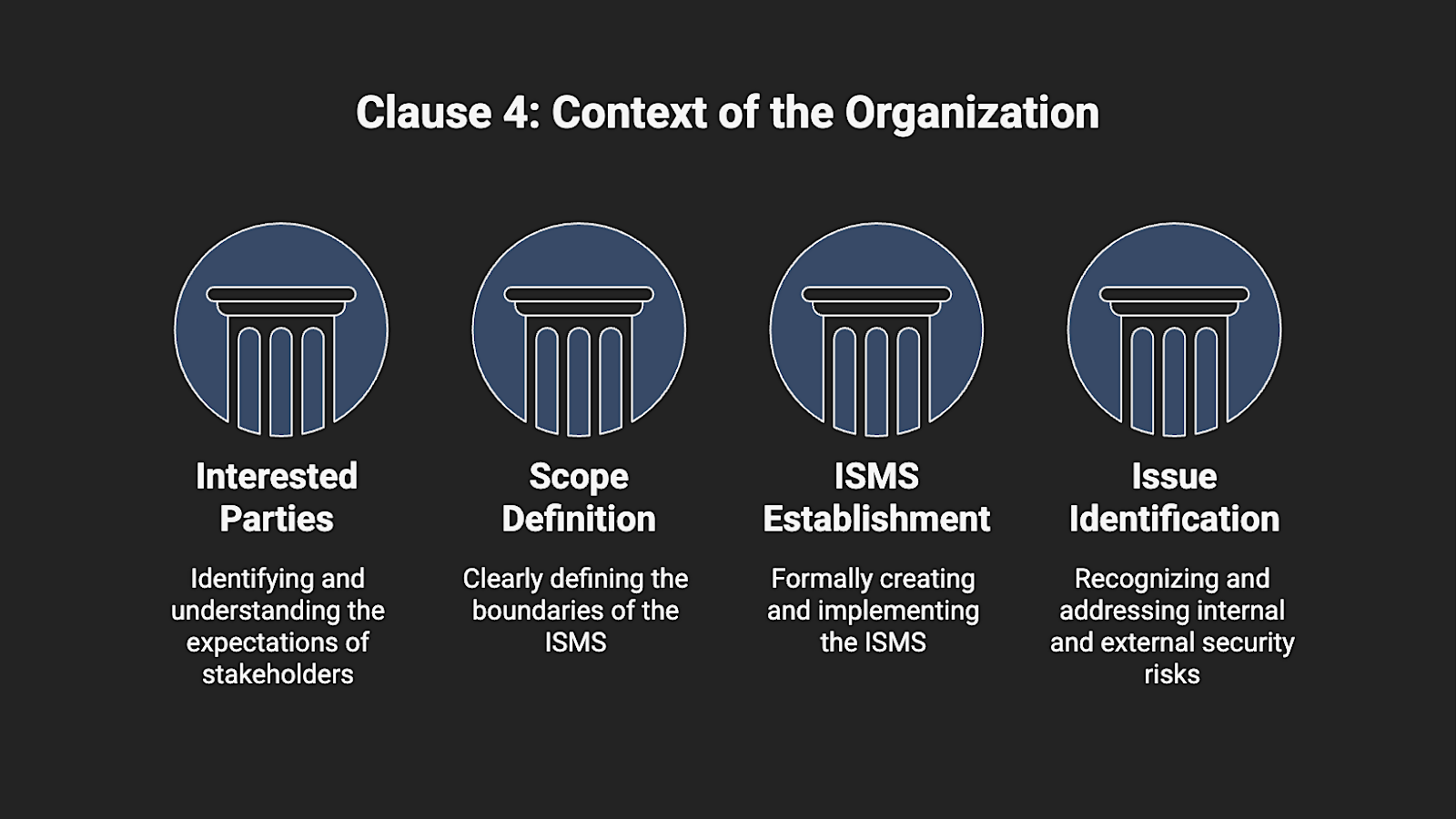
This clause is concerned with defining what your security program covers, so you aren’t using resources trying to protect things of little value to the business. It defines the scope of the ISMS and requires the organization to determine the factors that affect its operation.
Key requirements:
- Identify interested parties (like customers or regulators) and what they are expecting to see from your security program.
- Document the scope of your management system. Are you certifying the entire company or a specific department?
- Based on this defined scope and context, the organization formally establishes the ISMS.
- Identify internal and external issues that could affect your security program (including legal, regulatory, and contractual requirements)
Clause 5: Leadership
Effective information security works best with active participation from the board and executives. Clause 5 requires top management to take accountability for the ISMS and ensure it is formally established and actively supported.
Key requirements:
- Management must demonstrate commitment to security policies and also ensure the right resources are available.
- Roles and responsibilities need to be clearly assigned to facilitate accountability for security decisions.
- Leadership must also promote continual improvement of the ISMS and ensure it remains aligned with business objectives.
Clause 6: Planning
Three critical tasks are required by this clause: your organization must formally assess information security risks, determine how those risks will be treated, and establish measurable objectives for the ISMS. It pushes you out of the realm of vague intentions and into a documented security strategy.
Key requirements:
- Perform a formal risk assessment to find your most significant vulnerabilities.
- Create a risk treatment plan that explains exactly how you plan to address those gaps. Will you treat, avoid, transfer, or accept the risk?
- Set measurable goals like achieving 100% encryption on mobile devices by year’s end.
- Under Clause 6.1.3, complete the Statement of Applicability (SoA) to list what controls you will use and which don’t apply (and why).
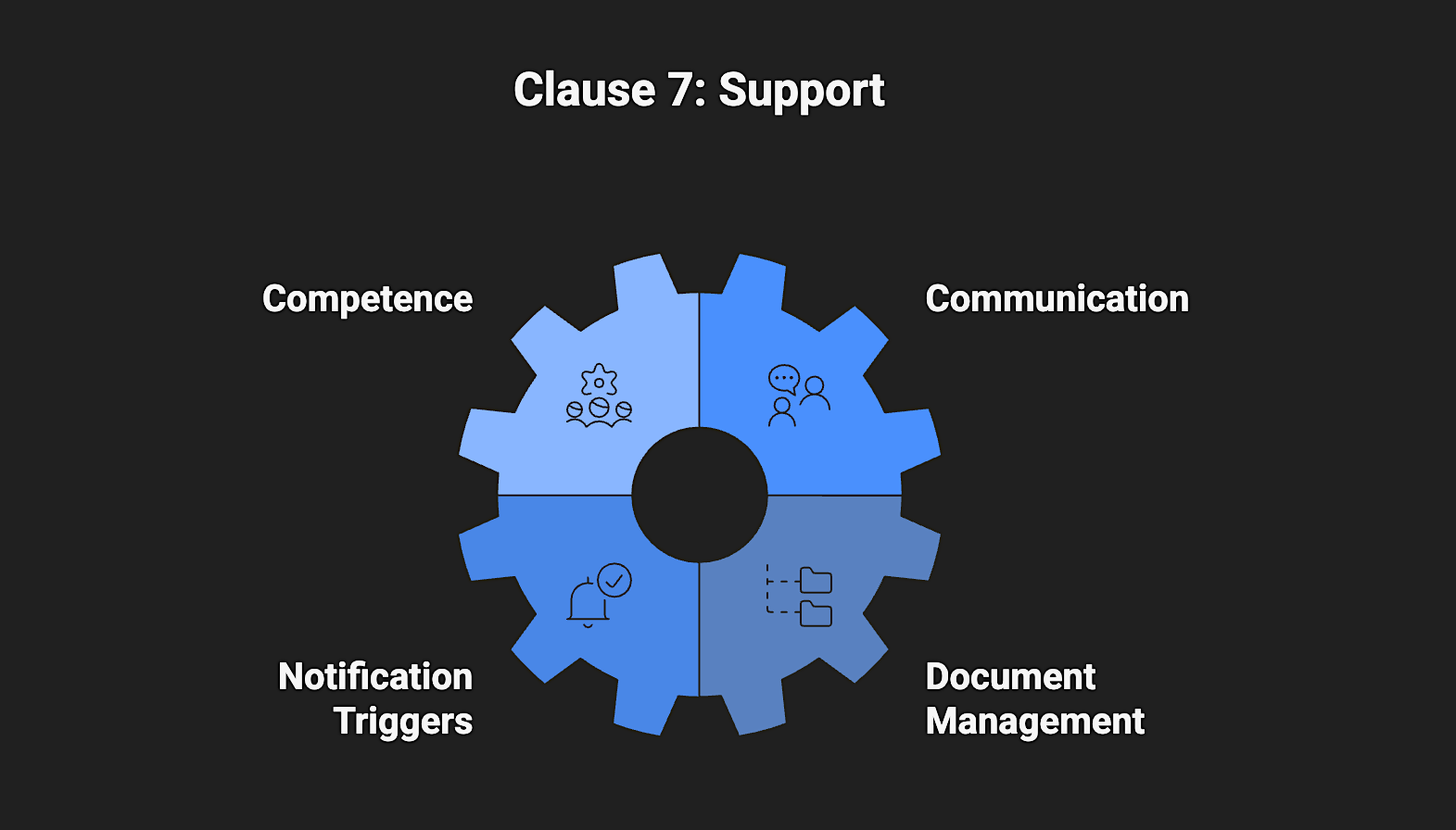
Clause 7: Support
This clause requires your organization to provide the resources, competence, communication processes, and documented information necessary to operate the ISMS effectively.
Key requirements:
- Verify the competence of your IT team or MSP. They need to have the right skills and experience to handle the security tasks. If they don’t, you need to provide training or hire a specialist.
- Decide how communication will work, such as internal reporting of security issues and external communication with clients or authorities during an incident. For example, a person should be designated who is authorized to speak on behalf of the company.
- Specify exact notification triggers for specific groups.
- Define processes for creating, updating, and protecting your security records. Everything must be documented for ISO 27001 compliance.
Clause 8: Operation
Clause 8 requires your organization to plan and control how the ISMS operates, including implementing risk treatment and managing changes that could affect information security. It’s where you take the plans and objectives you defined earlier and turn them into operational actions.
Key requirements:
- Put the actual security controls outlined in the SoA into place to mitigate risk.
- Outline rules for security processes so they are repeatable. For example, a rule might require all high-severity security vulnerabilities to be patched within 48 hours.
- Create a change management process to review the security impact of any change in the business (like a new cloud provider).
Clause 9: Performance Evaluation
It’s crucial to evaluate whether your security program is delivering on its objectives. To ensure your ISMS is performing as intended, this clause requires your organization to monitor, measure, audit, and review it regularly.
Key requirements:
- Continuously track performance metrics (these should be tied to the objectives outlined in Clause 6)
- Run your own internal audits to find and shore up issues before an external auditor.
- Present security data to leadership formally and at planned intervals, which provides valuable context to help executives decide if the strategy needs to change. You can use a CISO dashboard that converts technical control data into measurable risk indicators for executive oversight.
- Keep detailed records of all audits and the actions you’re taking to correct identified issues.
Clause 10: Improvement
The threat landscape will continue to change, so your security must also evolve. The Improvement Clause requires your organization to identify nonconformities and take corrective action to prevent them from recurring.
Key requirements:
- When a nonconformity is identified, determine its cause and take corrective action to prevent it from recurring.
- Follow up after implementing changes to verify that the fix solves the underlying risk.
- Document corrective actions and their results to demonstrate that issues have been properly addressed.
- Use data from Clause 9 to adjust your strategy. For example, if a certain type of attack is becoming more common in your industry, you’ll need to update your controls to mitigate the new risk.
How Organizations Use ISO 27001 Controls in Practice
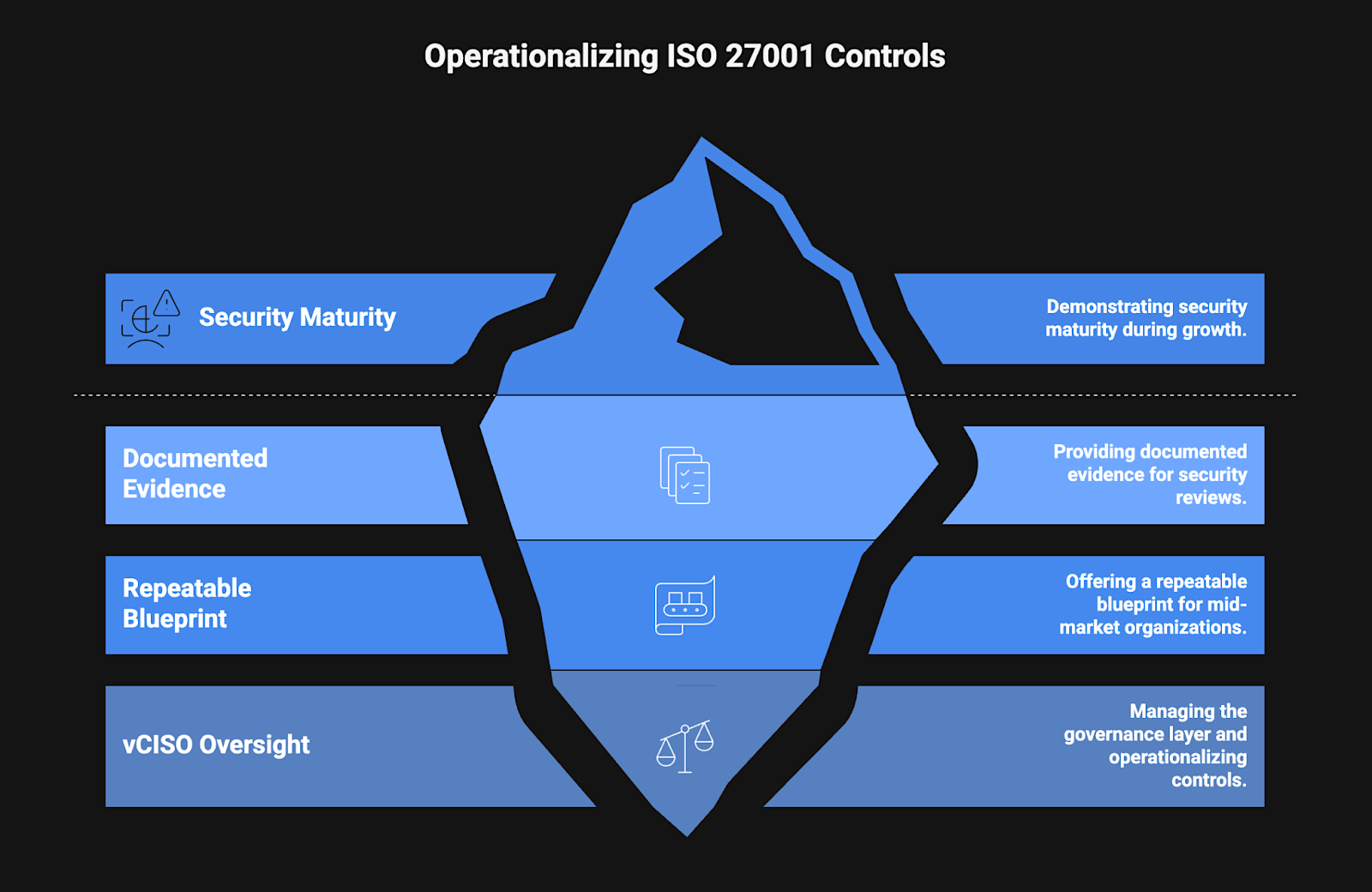
A mature organization is one that operationalizes ISO 27001 controls by integrating them into risk management processes and maintaining documented evidence of their implementation. When properly operationalized, ISO 27001 controls enable organizations to demonstrate security maturity during growth and external review.
Using ISO 27001 Controls in Security Reviews
When customers request a security review or regulators seek information, ISO 27001 controls require documented evidence that can be presented to demonstrate your security posture. You can build immediate trust with large enterprises through your Statement of Applicability, which maps that evidence to the selected controls.
Using ISO 27001 Controls to Enable Growth
Correctly implemented ISO 27001 controls provide a repeatable blueprint for mid-market organizations. If you’re bidding on government contracts, entering new markets, or facing M&A due diligence, being ISO-aligned removes friction that can kill these types of deals.
Using ISO 27001 Controls with vCISO Oversight
Building and maintaining this level of maturity can be a significant challenge for many mid-market leadership teams, particularly those with lean IT resources or heavy MSP reliance.
You don’t have to hire a full-time executive to get there, but you can hire a virtual CISO (vCISO) that partners with your organization to maintain ongoing ISMS oversight.
A vCISO manages the governance layer and operationalizes ISO 27001 controls to ensure audit evidence remains accurate and defensible, while supporting broader compliance initiatives such as SOC 2 and CMMC.
Operationalize ISO 27001 Controls with Vistrada
ISO 27001 controls provide a structured, risk-based approach to managing information security across your organization. When properly implemented, they support audit readiness and regulatory compliance. They also make it easier to communicate your security posture to customers and partners. Turning that framework into consistent, day-to-day execution is where many organizations struggle.
Vistrada delivers ISO 27001 oversight through a team-based, high-touch vCISO model. Instead of depending on a single advisor, your organization gains access to a coordinated bench of specialists who share responsibility for ongoing ISMS governance and audit readiness. The team oversees the SoA, defines control ownership, creates and maintains control testing playbooks, and conducts audit pre-reads to identify gaps early. The result is a defensive security program that scales with your growth.
Contact Vistrada to discover how its vCISO services help you implement and sustain ISO 27001 controls with confidence.