


Abstract:
- A zero trust framework combines access policies, ownership, and controls without granting implicit trust based on network location or asset ownership.
- Policies must define permitted actions and conditions that connected systems can enforce, including access by service identities.
- A pilot with a defined scope should test enforcement, access removal and recovery procedures, recording limitations, and business disruption.
- Expansion should follow verified enforcement, documented and acceptable risk treatment for unresolved exceptions, and an understanding of the next resource’s dependencies.
Your finance team needs to review invoices and submit payment requests. An external accountant needs access to some of the same records, while a payroll integration exchanges data automatically. Each requires different access permissions. Multifactor authentication (MFA) helps verify identity, but it doesn't determine what users or integrations can do once connected.
Understanding external dependencies is equally important. According to Verizon's 2026 Data Breach Investigations Report, third parties were involved in 48% of breaches. Although access controls address only part of this risk, teams need to know what external users and integrations can access, whether those permissions are appropriate, and who is responsible for reviewing them.
Building a zero trust framework starts with one manageable workflow. This guide outlines seven practical steps, from defining access policies and testing controls to protecting business continuity and deciding when to expand.
What is a zero trust framework?
A zero trust framework combines the policies, responsibilities, and architecture needed to put zero trust principles into practice. It provides a way to plan implementation rather than referring to a single official NIST framework.
NIST SP 800-207 provides architecture guidance based on verifying access to individual resources, without automatically trusting users or devices because of their ownership or network location. Authentication establishes identity, while authorization determines what access is permitted. NIST also provides practical implementation examples.
CISA's Zero Trust Maturity Model helps organizations assess progress across five pillars: identity, devices, networks, applications and workloads, and data. It does not create a compliance requirement for private-sector organizations.
The following steps outline a practical approach to planning a first zero trust pilot, rather than an official NIST implementation methodology.
7 Steps to Building a Zero Trust Framework
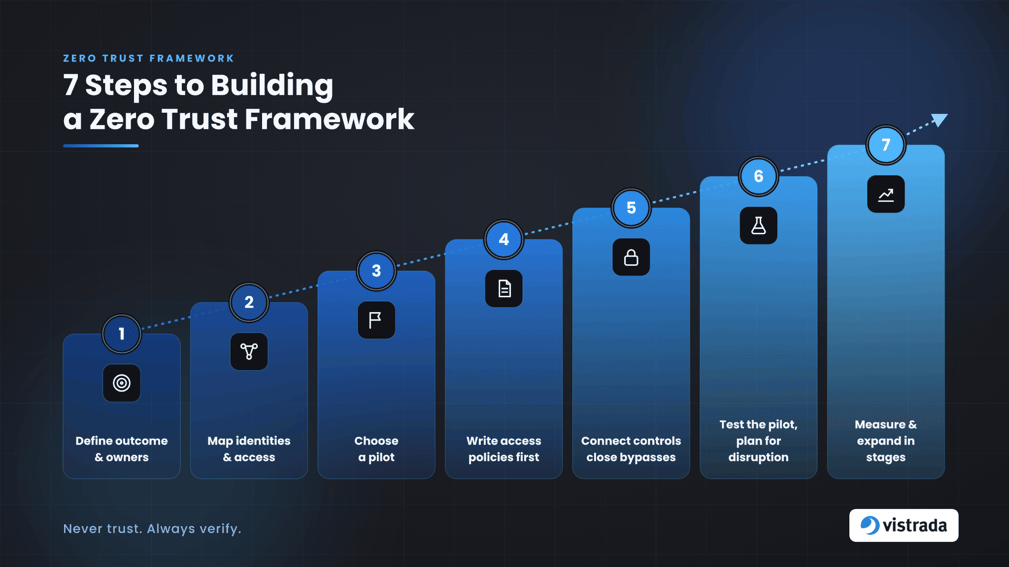
Step 1: Define the business outcome and assign owners
Start with an access decision the business owner can explain. For finance, restricting access to approved roles under documented conditions gives IT something to configure and the owner something to test. Before committing to a tool or rollout date, agree on the work users must be able to complete.
Take a fictional mid-market services firm with a small IT team and a managed service provider (MSP). Its finance director wants staff to view invoices and submit payment requests, with payment approval reserved for a separate role. The firm uses a SaaS finance application. In this example, the team has to tighten access while keeping accounting and payroll running.
The finance director defines the business requirements, while the security lead agrees the controls, and IT or the MSP implements them. An executive sponsor resolves competing priorities. The charter must also identify who can accept residual risk. An MSP may configure a rule, but the organization still needs someone with authority to approve the risk of an exception.
Put those responsibilities in a short pilot charter alongside the scope and success measures. Name the essential tasks, including invoice review and payroll processing. You will use them to work out which dependencies need testing before changing access.
Step 2: Map resources, identities and access dependencies
Use the charter to map who needs the application and what they do with it. Include privileged accounts and contractors as well as employees. Service identities need their own entry: software uses them to act without a person signing in. For each identity, trace the device or integration it uses and the path it takes to the application.
At the services firm, staff use managed laptops, the external accountant needs limited access, and payroll exchanges data through an application interface. An employee account list would leave out that payroll connection. Applying a human-login rule to it could interrupt payroll if the integration cannot support that authentication method.
The payroll owner should confirm the integration’s identity, required permissions and operating schedule. The accountant can explain which records and actions the engagement requires. Give someone responsibility for investigating any unanswered questions. Monitoring non-human identity activity can help you compare those descriptions with how service accounts and integrations are used.
As you map access, note which identity, device-management and logging capabilities you have. Look for direct application logins or other routes around the proposed control. Continue discovery beyond the pilot’s boundaries; this first map covers one workflow and leaves the wider organization’s inventory unfinished.
Step 3: Choose a pilot with manageable dependencies
Choose a pilot whose owner can take part and whose dependencies you can investigate. Business exposure matters, but you also need enough evidence to tell what happened during a test. Before selecting a candidate, ask IT how it would reverse a harmful configuration change and how the owner would confirm that essential work had resumed.
For the services firm, the comparison might look like this. Another organization could reach a different decision from the same three candidates.
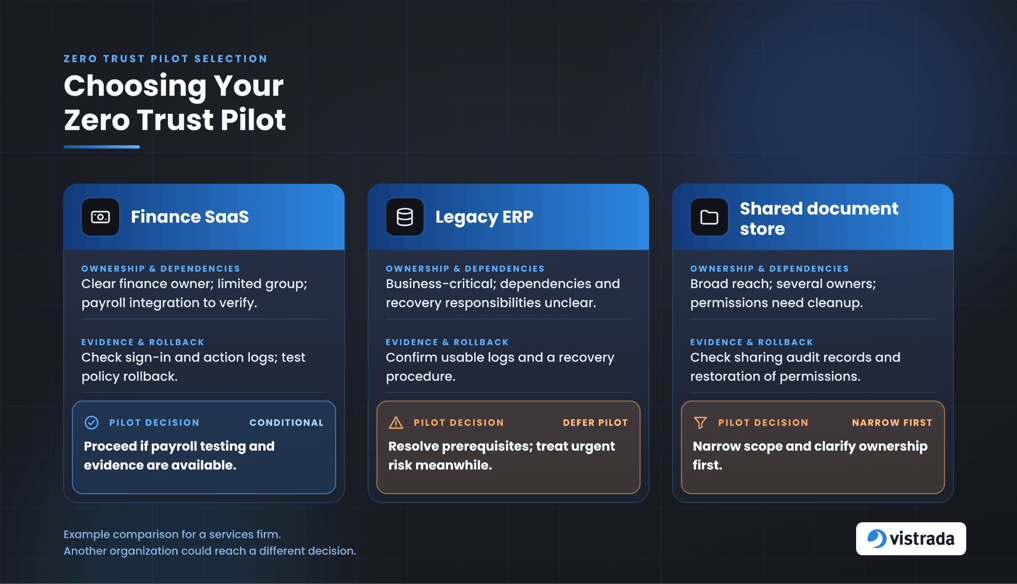
Finance is a workable first choice if the director can participate and the team can test payroll without disrupting production. The small user group makes coordination easier. The deciding issue, though, is whether the team can observe and test the integration. If the payroll provider cannot support testing, resolve that prerequisite before proceeding.
Keep a record of the choice and what must happen before you revisit the other candidates. The ERP owner still needs to address urgent exposure while investigating dependencies and recovery.
Deferring its zero trust pilot does not remove that responsibility. Assign interim risk treatment so the first pilot does not draw attention away from a more serious existing weakness.
Step 4: Write access policies before configuring controls
Write each rule around a subject or workload, the resource it needs, the requested action, the relevant conditions, and the resulting decision. Include the action even if the user has authenticated. A finance employee may need to submit a payment request without having authority to approve it; IT must be able to distinguish those permissions in the application.
The finance and security owners could agree on a rule such as:
Members of the approved finance role may view invoices and submit payment requests in the finance application from managed devices that meet documented posture requirements, after completing the required authentication. This rule does not authorize payment approval.
For device posture, specify the security conditions you can assess, such as required protection software and update status. Name the evidence IT will use to check them. If a request fails the rule, the control must deny it or direct it to a defined remediation or exception process. The approver must authorize an exception before access is granted.
Set up a separate role for the accountant, limited to the engagement’s records and actions, with an expiry date. The payroll integration needs a workload identity and permissions for its required operations. Its authentication method must suit an automated process that cannot complete a human MFA prompt.
Give each exception an approver and expiry, and document the compensating controls. In the policy register, pair each rule with its enforcement location and a test. IT can then use that register for access policy planning across systems and identify rules that the existing controls cannot yet enforce.
Step 5: Connect controls and close bypass paths
Map the policy register to the identity, endpoint, application and network controls you have. An endpoint management system might record that a laptop meets security requirements. To use that record for conditional access, the relevant access-control system must receive and evaluate it. Until the integration works, IT may be able to see the device’s condition without enforcing the intended rule. Check the integration and the quality of its signals before buying another tool.
NIST distinguishes three logical functions. The policy engine decides whether to grant access. The policy administrator carries out that decision by establishing or shutting down the communication path, while the policy enforcement point enables, monitors and terminates access. A product may combine these functions, so you do not need to buy one product for each.
Trace that sequence for the finance application: how does IT confirm the user’s role, obtain device posture and enforce transaction permissions? Then locate the logs for the decision and the action. To verify that staff cannot approve payments, the investigator needs evidence of application permissions or behavior as well as the sign-in record.
Test the routes outside that sequence too. Someone might use a direct login or a service credential with broad privileges to bypass part of the policy. Where network paths matter, use segmentation to limit unnecessary reach. Zero trust network access (ZTNA) can address connectivity; the team must still manage application permissions and operating procedures. Record integration gaps in the control map and give each one a remediation owner.
Use a cybersecurity gap assessment within the pilot’s scope to compare the controls you need with the capabilities you have. That comparison helps the owners decide which gaps need remediation before testing.
Step 6: Test the pilot and prepare for disruption
Agree with the finance owner on the expected results before changing access. Start in observation or report-only mode where the technology supports it, then roll out controls to a limited group. During testing, the owner can help distinguish a correct denial from a rule that prevents legitimate work.
For this finance pilot, include these acceptance checks:
- An approved staff member can review invoices and submit a request, but cannot approve payment.
- A device that fails the agreed posture requirement receives the expected access decision.
- Removing a user’s access produces the documented result for new and existing sessions.
- Payroll completes its permitted work, while its identity cannot perform an unrelated operation.
- During a key dependency outage, verify the documented response procedure, including whether approved emergency access, an alternative workflow or rollback can safely restore essential business operations. Test each applicable option and record its limitations.
Check how the chosen architecture handles reassessment and revocation. The behavior depends on available signals and integrations, as well as the enforcement point’s capabilities. Do not assume a product reauthenticates a session throughout its duration because it supports zero trust.
Compare expected results with what happened, including delays and limitations. An investigator should be able to reconstruct the access decision and action from the logs. For emergency access, name the approver and the person monitoring its use, and document how normal restrictions resume. Agree on a go/no-go decision with the business owner. Keep expansion on hold while you investigate unexplained denials, bypasses, or missing evidence; passing these checks does not establish complete security.
Step 7: Measure results and expand in stages
Measure the outcomes in the charter using evidence from the tests. For policy coverage, count the documented finance access paths where you have verified enforcement, then compare that count with all identified paths in the same scope. Keep the denominator visible so the owner can see what remains untested, including integrations.
Give each measure an owner and, where possible, capture a baseline before rollout. Track the age of unresolved exceptions and any disruption to legitimate access. Treat a rise in blocked attempts as something to investigate: staff may have changed how they work, or IT may have misconfigured a rule. Confirm the cause before reporting better enforcement.
For access-removal time, measure from the approved removal decision to confirmed enforcement. Agree on a target that suits the resource and architecture. In the finance pilot, test both an existing session and a new login after removing a user. If the new login fails but the session remains active, report those results separately so the owner can assess the remaining access.
Use a CISO dashboard to bring policy coverage, exception age and access-related disruption into the leadership review. The owners should be able to explain what each result means and which decisions remain open.
Review the findings with the finance owner and MSP before choosing the next resource. Confirm that the pilot’s policies work as intended and that unresolved exceptions have documented, acceptable risk treatment. These checks give the owners a basis for deciding whether the team can expand or needs to resolve problems first.
The next resource needs its own dependency review. Reuse validated policies where the requirements match, but check the differences: a document store may need sharing and ownership rules that the finance pilot never tested. Use that review to set implementation prerequisites and assign owners for the next phase.
Continue reviewing access as roles, applications and risks change. Feed identified access weaknesses into your broader exposure management efforts so they can be assessed alongside other security risks and prioritized for remediation.
Start with one accountable, testable pilot
Choose one resource and ask its business owner which access decision needs attention. Agree on the pilot’s boundaries before IT changes a control. Keep the policy, enforcement location, and test evidence together so whoever takes responsibility next can understand the rule and its limits.
If your team needs more capacity to map dependencies or carry out remediation, Vistrada’s vCISO services provide security leadership through a CISO backed by specialists. Your team can draw on that support to develop policies and coordinate the work in its security roadmap.