


Your organization does not need to call itself AI-first to be exposed to AI risk. Many tools used for hiring, productivity, finance, and security already have generative features, smart recommendations, summarization, and automated decision support. While it may not look like a governance problem at first, those systems can introduce risk when they influence business decisions or touch sensitive data.
AI adoption is moving faster than the internal processes needed to govern it, and many organizations are now facing these challenges. AI-related incident reports rose sharply in 2025, with at least one material AI risk disclosed by 72% of the S&P 500 companies. The NIST AI Risk Management Framework (RMF) 1.0 Official was created to give organizations a structured way to assess and manage AI risk, and it applies to any organization that designs, develops, deploys, or uses AI systems.
For organizations with limited internal security leadership, knowing what needs to be done is very different from assigning ownership and operationalizing governance in a way that actually manages risk. This guide outlines what you need to know about the NIST AI RMF 1.0, including best practices for applying it in a realistic, manageable way.
The NIST AI Risk Management Framework 1.0 Official: What is it, exactly?
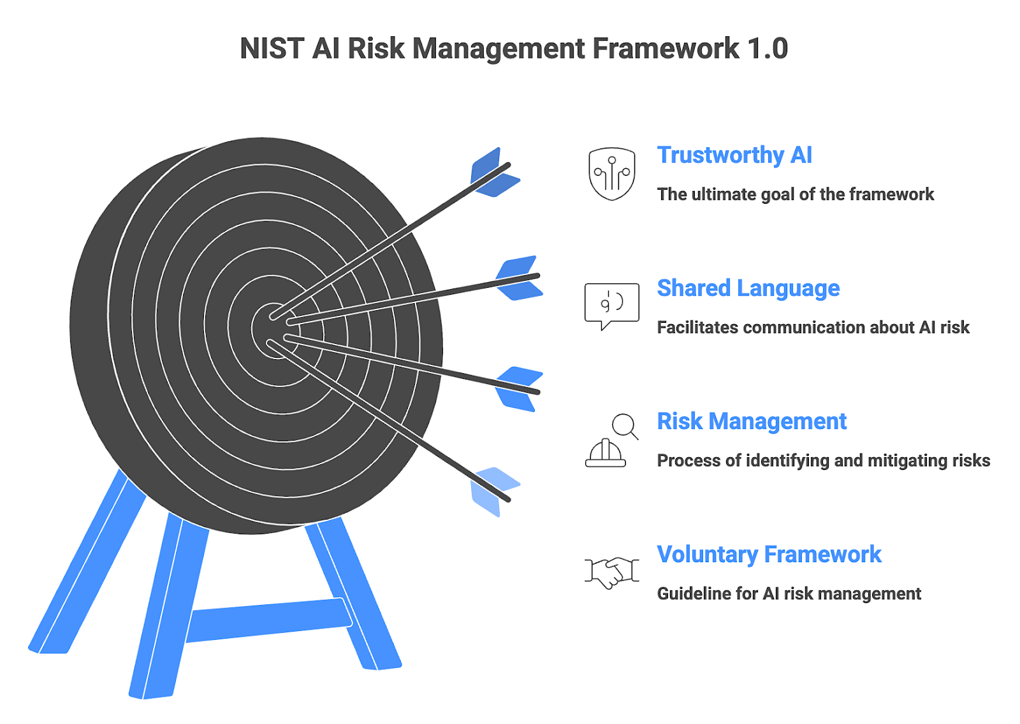
The NIST AI Risk Management Framework 1.0 is a voluntary framework from the U.S. National Institute of Standards and Technology (NIST) to help organizations identify, assess, and manage risks associated with AI systems. It was developed through an open, consensus-driven process and released on January 26, 2023.
The framework is designed to support two goals:
- Give organizations a shared language and structure for discussing AI risk internally and with partners, auditors, and regulators.
- Promote trustworthy AI by directing attention toward specific characteristics that make a system reliable.
It’s important to note that it’s not limited to any one model type, vendor, or sector, and the framework is not a replacement for your regulatory obligations.
Who should use the NIST AI Risk Management Framework 1.0?
NIST designed the official AI Risk Management Framework 1.0 for any organization involved in any stage of the AI lifecycle, such as:
- Organizations developing or tuning AI systems, including software companies, AI vendors, defense contractors working with automated systems, and internal IT teams creating AI-assisted tools.
- Organizations that buy AI-enabled products who are still exposed to risk, even if it is not immediately visible. The deploying organization is responsible for how a tool is configured and used downstream.
- Business and security leaders responsible for governance, such as CISOs, CIOs, chief risk officers, and compliance leads.
- Organizations in regulated or audit-sensitive industries, such as financial services, healthcare, defense, insurance, and legal.
Why do organizations need the NIST AI Risk Management Framework 1.0?
AI Risk Often Looks Normal, Until It Isn’t
Where traditional software breaks in ways that are obvious and reproducible (like an application crashing or an API throwing an error), AI models can continue to generate convincing outputs even when performance is degrading as data distributions change.
AI inaccuracies are harder to spot because they don’t trigger an obvious alert, which results in organizations carrying compliance and operational risk for extended periods before detecting that anything has gone wrong.
With a recent survey indicating that 51% of respondents from organizations using AI say their organizations have experienced at least one instance of a negative consequence (and almost one-third of all respondents reporting consequences stemming from AI inaccuracy), the regulatory attention around AI is picking up speed.
For example, 20 different proposals for AI legislation were offered in the US Congress in 2025 alone. Organizations with no formal AI risk program are behind where the market is moving.
Third-Party AI Still Requires Governance
Additionally, many mid-market organizations also rely on SaaS platforms that include AI features they didn’t explicitly select. Even when a third party provides the AI model, the deploying organization is still responsible for understanding how those features are configured, where organizational data may be exposed, and what kinds of downstream decisions or actions the system can influence. Without a structured review process, that exposure is easy to miss.
For example, a common scenario is when a trusted business platform adds an AI feature that can access sensitive data or influence downstream decisions, even though the organization never treated it as a separate AI deployment.
These situations are where the NIST AI Risk Management Framework 1.0 Official offers real value. It gives teams a more repeatable way to identify AI use, map exposure and failure scenarios, and evaluate risk more consistently than vendor assurances or scattered review processes.
What are the 4 Core Functions of the NIST AI RMF 1.0?
The NIST AI Risk Management Framework 1.0 Official is centered on a set of trustworthiness characteristics that model what responsible AI looks like.
NIST identifies these as valid and reliable, safe, secure, and resilient, accountable and transparent, explainable and interpretable, privacy-enhanced, and fair with harmful bias managed. These characteristics give organizations a practical way to evaluate whether an AI system is operating in a manner that supports trustworthy outcomes in its specific context.
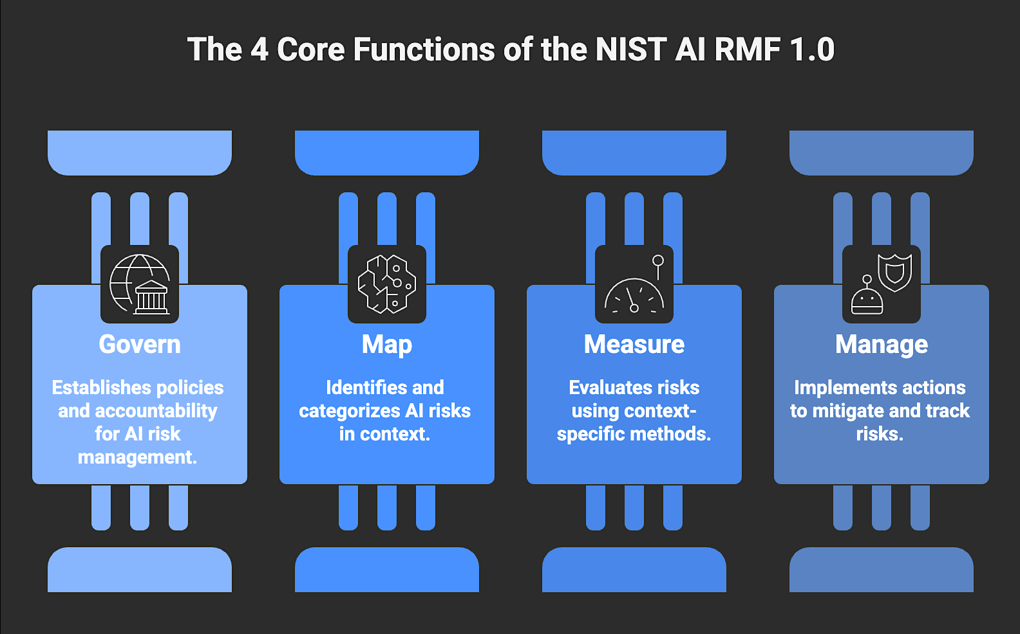
The framework then turns those characteristics into four core functions that support continuous risk management:
- Govern establishes a foundation of policies, accountability structures, defined roles, and oversight conditions that make the other three functions workable.
- Map focuses on identifying and categorizing AI risks in context. Mapping makes later risk analysis useful because it ties measurement to the system and its points of exposure. It also needs to be revisited as those conditions change.
- Measure evaluates the mapped risks using context-specific methods to assess performance, impacts, and trustworthiness. It includes assessing for bias, reliability, and alignment with your risk tolerance thresholds. This evaluation is used as evidence for governance and management decisions.
- Manage turns those findings into action. It covers prioritizing risks, applying mitigations, tracking remediation, and maintaining an updated risk posture. It also addresses incident response.
7 Steps to Implement the NIST AI Risk Management Framework 1.0
It’s important to understand that NIST does not expect teams to follow the official AI RMF Framework 1.0 in a rigid order. In fact, NIST’s own Playbook states it is “neither a checklist nor an ordered list of steps.”
The following steps are arranged in a practical way to help your organization get started with implementing the framework.
1. Establish Internal Ownership for AI Risk Management
Assign accountability for AI governance to a specific leader, who is usually the CISO, CIO, or chief risk officer. They must have the authority to carry out the following responsibilities:
- Approve new AI use cases and deployments
- Establish oversight responsibilities across security, legal, privacy, and technical teams
- Create baseline policies governing acceptable AI use.
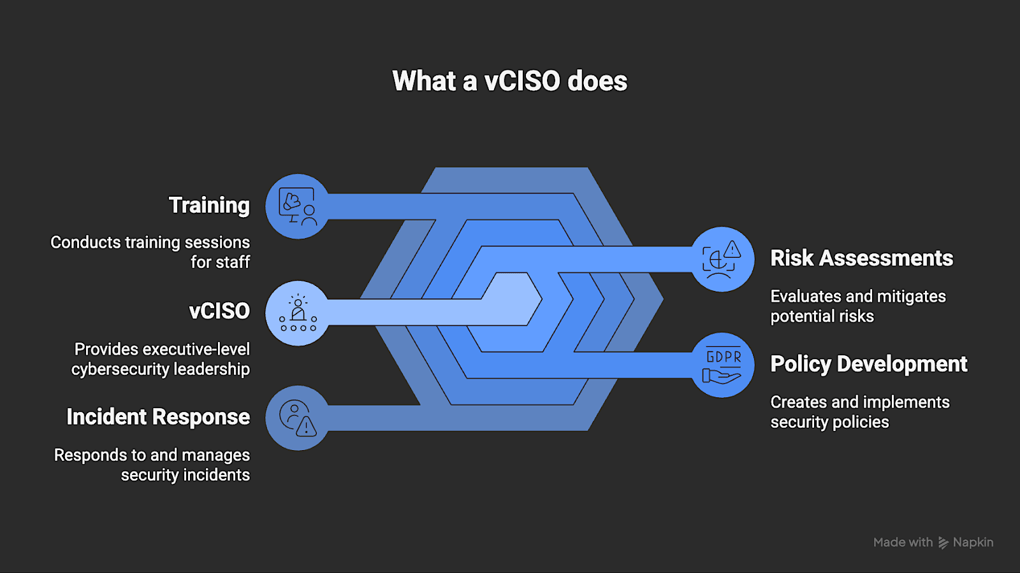
For organizations without a dedicated security executive, a team-based vCISO model can give AI risk management clear ownership from day one. Vistrada’s vCISO service combines executive guidance with specialist support to help structure and operationalize AI governance without the need for a full-time internal hire.
2. Inventory AI Systems and Tools in Use
Before risks can be managed, you need a clear picture of where AI is already operating across the business. Document every AI system currently in use and don’t neglect to include third-party platforms with AI features.
For each AI system, record the following information:
- Business function it supports
- Operational impact if the system fails or produces incorrect output
- The types of data it handles (especially sensitive or regulated data)
- Its dependencies on external vendors, APIs, integrated platforms, or data sources
- Any downstream systems the tool can affect (through outputs or integrations)
3. Prioritize the AI systems That Present the Greatest Risk
Identify which AI systems need review first by prioritizing the ones with the greatest potential impact. Use the following factors to rank each system:
- Place systems that impact customer-facing decisions, financial outcomes, or safety-sensitive operations in the highest-risk tier.
- Flag systems that can trigger actions without human review.
- Give higher priority to systems that handle sensitive or regulated data.
This prioritization should guide where to focus deeper assessments and governance review.
4. Evaluate Risks Before Deploying or Expanding AI Use
Before an AI system is deployed in production, or before its use is materially expanded, assess where it could create security, privacy, reliability, third-party, or compliance problems as part of a pre-deployment or pre-expansion risk engineering review:
- Review the training data when that information is available, along with the production data that the system will handle. Pay close attention to any points where sensitive information could be exposed. If the system relies on a third-party AI provider, also review vendor disclosures, data flows, and any limitations around data handling and model transparency.
- Test how the system performs under realistic conditions, and include edge cases and failure scenarios. Evaluate reliability in practical terms, including output consistency, failure under stress, and the risk of inaccurate or misleading responses.
- Check for bias and uneven performance, especially if a system could affect downstream business decisions.
- Document any regulatory or contractual concerns before deployment. This should include privacy obligations, customer or vendor contract requirements, internal governance expectations, and any sector-specific compliance considerations.
5. Implement Governance, Security, and Operational Safeguards
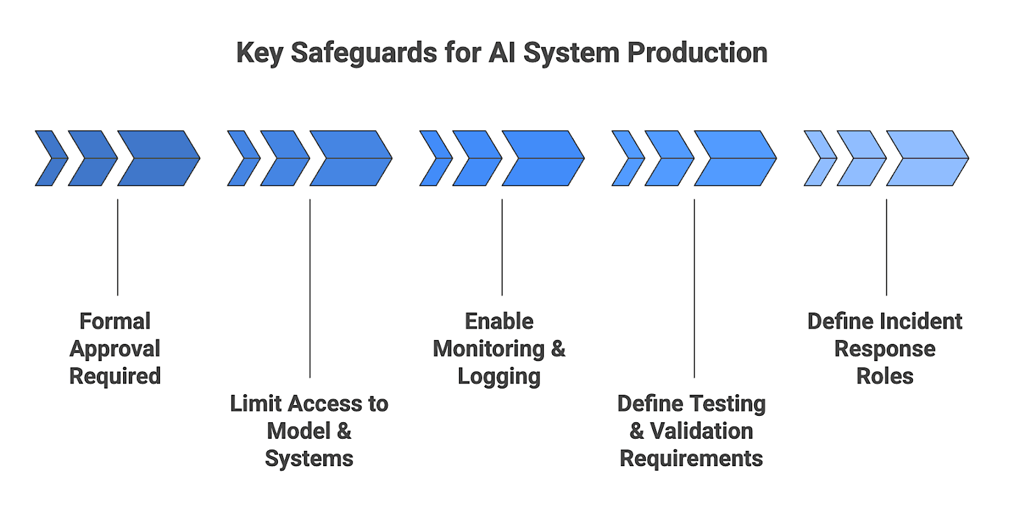
An AI system should move into production only after the required governance, security, and operational controls are defined and in place for production use. Those safeguards should include the following measures:
- Require formal approval before a new AI system goes live or an existing one is materially changed.
- Limit access to the model and the systems around it, including any connected data flows.
- Enable monitoring and logging so system activity remains visible after deployment.
- Define testing and validation requirements that must be completed before production use.
- Define who needs to be involved when failures, policy issues, or unexpected behavior are identified.
For organizations with limited internal security or compliance resources, this is often where team-based vCISO support becomes valuable for structuring the review, identifying gaps, and coordinating the right follow-on actions.
6. Monitor AI Systems and Update Risk Evaluations Over Time
Once an AI system is live, risk needs to be reviewed on an ongoing basis by:
- Monitoring production performance against defined KPIs, such as accuracy, response quality, exception rates, and human override rates.
- Consistently reviewing the system again for major changes, such as when new data sources are introduced or the use case expands.
- Updating risk documentation and supporting controls when internal policies shift or new regulations apply.
Ongoing oversight from a CISO or vCISO can keep these reviews consistent as systems and regulations change.
7. Maintain Documentation and Audit Visibility
Documentation is what allows an organization to show, not just say, that AI risk is being governed. Your documentation program should include the following records and reporting:
- Maintain an up-to-date inventory of all AI systems.
- Risk assessments, approval records, validation results, and exception decisions for each system.
- Reporting that supports audit readiness and leadership visibility, including AI use, risk status, pending reviews, and unresolved issues across the environment.
Don't Let AI Outpace Your Governance Program
The NIST AI Risk Management Framework 1.0 Official gives teams a way to evaluate AI use more consistently, document decisions, and put structure around risk before problems appear in production or during an audit. But for many mid-market organizations, the real problem is finding the ownership and internal capacity to apply this framework while already managing existing governance and regulatory demands.
For those situations, Vistrada provides NIST AI RMF 1.0 implementation leadership through comprehensive vCISO services. It’s a team-based model that combines executive oversight and specialist support to help organizations assess AI risk, build governance documentation, and maintain oversight as AI use expands. For organizations operating in regulated environments, Vistrada can also help connect AI governance efforts to broader programs involving SOC 2, ISO 27001, and CMMC.
Connect with Vistrada to explore how vCISO services can help your organization move from AI awareness to working governance.