

It’s easy to forget how much of a mid-market company’s work depends on outside providers. HR systems, finance tools, CRM platforms, support vendors, and collaboration apps all touch regulated data and link into production. Many rely on subcontractors, which extends access even further.
When there’s no method for ranking high-impact relationships, teams often review the wrong ones, leaving bigger gaps open. That leads to slow customer reviews, renewal surprises, and higher incident and insurance costs.
A recent survey of business leaders revealed that over 82% had faced consequences due to third-party risks in the past year, and that improving third-party risk management was now their primary focus. A vendor risk assessment closes those gaps and improves risk management by standardizing the process of reviewing third parties. It sorts vendors by importance, validates safeguards with evidence, ties protections to the contract, and documents remediation. Leadership can point to it when customers, auditors, or insurers ask for proof.
Lean teams handle this best as an ongoing program with shared templates, standard terms, and leadership reporting. Many companies rely on a team-based, vCISO-led model with specialist support to get it up and running quickly. This guide covers everything you need to know to run a repeatable vendor risk assessment, including a checklist to maintain a consistent review scope and evidence.
What is a vendor risk assessment, and why does it matter?
A vendor risk assessment reviews how a provider handles your sensitive data (such as CUI Basic), connects to your environment, and supports key processes. It highlights potential trouble spots and validates through evidence that the vendor’s controls are strong enough for the role they play.
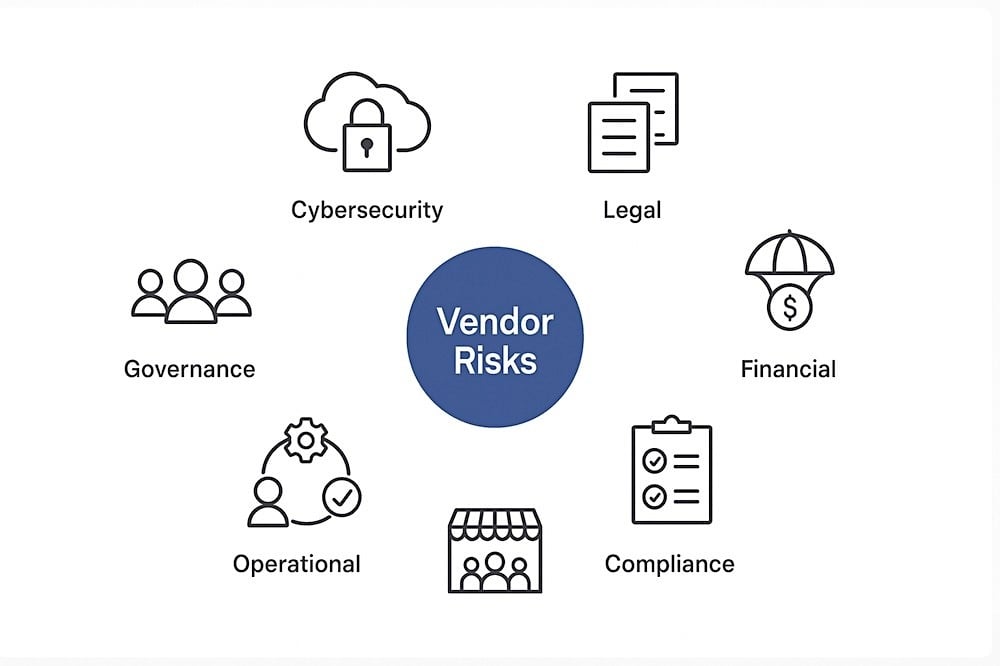
The assessment focuses on core areas where vendors can introduce risk:
- Security: Access control, authentication, system protection, logging
- Privacy: Data handling, storage, sharing, and regional obligations
- Operations: Stability, backups, recovery, change control
- Financial and Reputational: Stability and past issues
- Resilience: Response to outages and dependencies
- Fourth-party: Oversight of their own subcontractors
Instead of taking vendors at their word, decisions rest on verified controls and repeatable steps. It helps people make clearer go or no-go decisions, set the right contract terms, speed customer security reviews, and build reporting that leadership can trust.
How often should vendor risk assessments be conducted?
Vendor risk assessments line up with key points in the lifecycle. They should occur at these times, regardless of the vendor’s risk level:
- During onboarding, before signing the contract
- Before contract renewal
- After any vendor incident
- After any meaningful change to the data involved, the vendor’s access level, their hosting environment, operating regions, ownership, or subcontractors
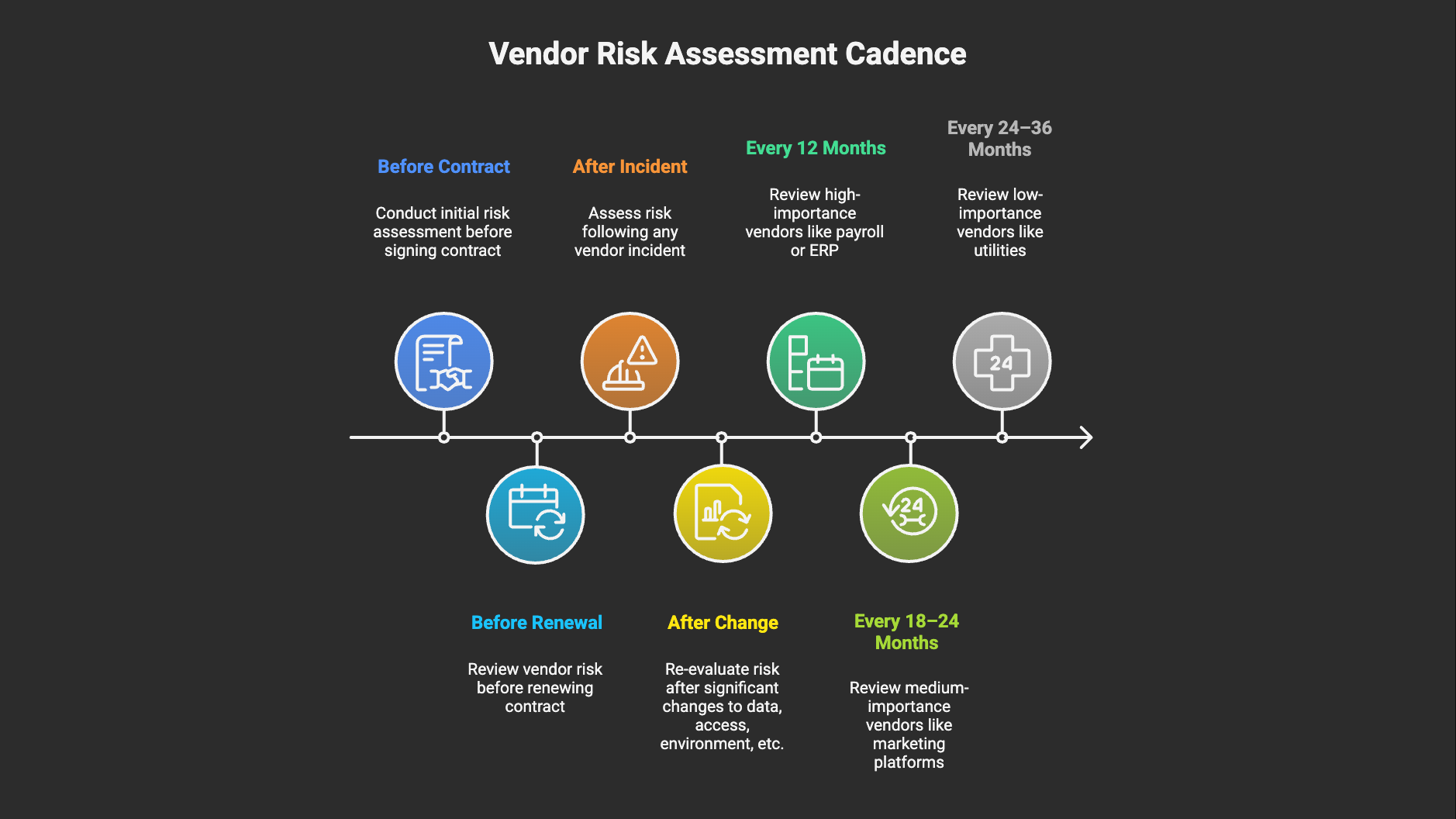
The scheduled review cadence will depend on how vital the vendor is to the business:
- High-importance vendors such as payroll or ERP platforms should be reviewed every 12 months.
- Medium-importance vendors, such as marketing platforms or collaboration tools, every 18–24 months.
- Low-importance vendors, such as basic utilities or low-access tools, every 24–36 months.
Evidence has a limited shelf life. Independent assessments and test summaries should be dated within the past 12 months. Certificates must be current, and policies should show a review within the past year. If anything is outdated, ask the vendor for a brief attestation and the date they expect to update it.
Make this process a part of the relationship, and set expectations early with the vendor. Include cadence and triggers in the MSA and onboarding materials, and be sure to put annual reviews for high-importance vendors on the calendar early.
Why You Need a Vendor Risk Assessment Checklist
A vendor risk assessment checklist adds structure and avoids the inconsistencies that can occur when different people run assessments. It provides every reviewer with the same questions, steps, and decision logic, ensuring that each conclusion is tied back to documented evidence.
It also improves coordination. Security, procurement, legal, and business owners follow a precise sequence and set of handoffs. This process cuts down on ad hoc requests and helps the review move faster.
The result is a solid audit trail. Findings, scores, evidence, dates, and remediation progress all live in one place. That record supports various customer questionnaires, insurance reviews, and executive reporting, including CISO dashboards, while directing efforts toward vendors with the most significant impact.
Download your free Vendor Risk Assessment Checklist [XLS] for more effective assessments and improved compliance.
9 Steps for an Effective Vendor Risk Assessment
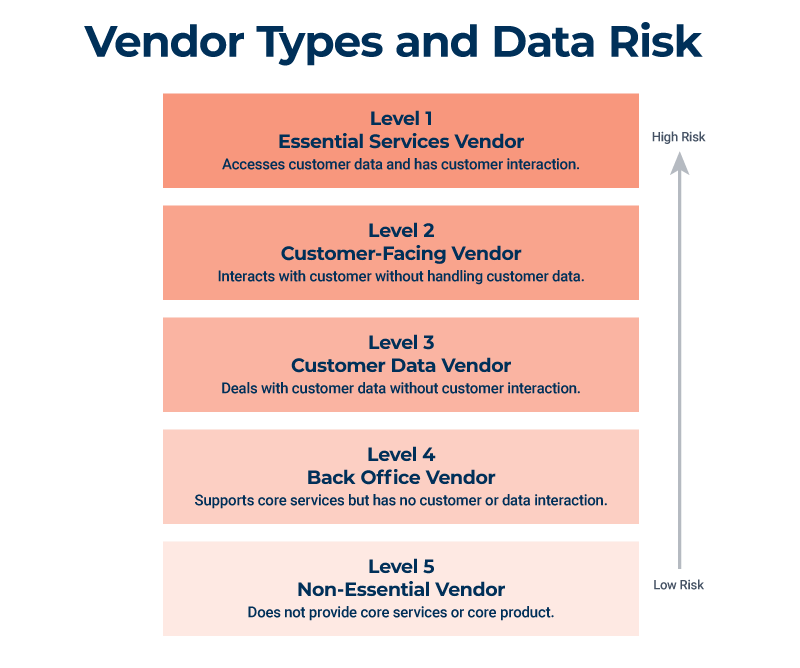
Step 1: Build a Vendor Inventory and Tiering Model
Start by creating a complete list of vendors and the access they have to your systems and data. This step creates the baseline for assessment and helps security leaders understand which relationships deserve the most attention. Unknown vendors can’t be reviewed, and a tiering model directs effort where the impact is highest.
To build the inventory:
- Pull accounts payable (AP) exports to capture everyone paid outside payroll.
- Review single sign-on (SSO) and virtual private network (VPN) logs for additional relationships not in AP.
- Talk with business owners to confirm the current identity and access governance (IGA) situation, data types, integrations, and where data is stored and processed.
- Classify each vendor as High, Medium, or Low based on business impact if the vendor fails or leaks data.
Step 2: Define Risk Categories and a Weighted Scoring Model
Build a vendor risk assessment scoring framework that reflects the exposure they introduce. A clear model removes subjectivity and produces scores that can be compared across the entire inventory. It also gives business owners a shared reference point for how decisions are made.
To create the scoring model:
- Create a weighted model that totals to a score from 0 to 100.
- Assign a higher weight to safeguards that directly protect sensitive data or critical operations.
- Document what High, Medium, and Low residual risk mean with clear thresholds.
- Make the scoring guide available to business owners so decisions are transparent and consistent.
Step 3: Determine Inherent Risk and Scope the Assessment
Identify the level of exposure a vendor introduces before looking at any of its controls. This scoping approach keeps the vendor risk assessment proportionate to impact. It avoids deep reviews for low-impact vendors and ensures high-impact relationships get the right level of attention.
To scope the assessment:
- Ask targeted questions. Does the vendor store, process, or transmit regulated data? Does it have privileged access? Does it sit on a critical workflow? Are there data residency or cross-border transfer requirements?
- Use these answers to choose between a short-form questionnaire or a full assessment.
- Specify the exact documents and screenshots to request, including acceptable formats, so the vendor understands what to provide.
Step 4: Collect and Verify Evidence
During the vendor risk assessment, collect proof that the vendor’s controls are real and operating as intended. Clear evidence shortens audits and cuts down on back-and-forth. It also creates a foundation that leadership can rely on when evaluating risk.
To verify evidence:
- Request current SOC 2 reports, ISO certificates, penetration test summaries, and data flow diagrams as applicable.
- Request simple screenshots that display multifactor authentication (MFA), patch status, backups, or logging.
- Check issue and renewal dates to confirm the material is current.
- Flag items older than 12 months and request an updated version or a short attestation.
Step 5: Evaluate Controls Against Recognized Risk Themes
Review the vendor’s safeguards across the areas where failures tend to cause the most disruption. The vendor risk assessment identifies which controls aren’t strong enough and where the vendor may be vulnerable during an outage or security issue.
To evaluate controls:
- Examine identity and access practices, authentication, encryption, monitoring, backups, incident handling, secure development lifecycle (SDLC), change management, and vendor oversight.
- Mark each area as meeting requirements, having a gap, or having a compensating measure.
- Capture the business impact of each gap so the findings can be prioritized effectively.
Step 6: Score, Document Findings, and Risk-rank
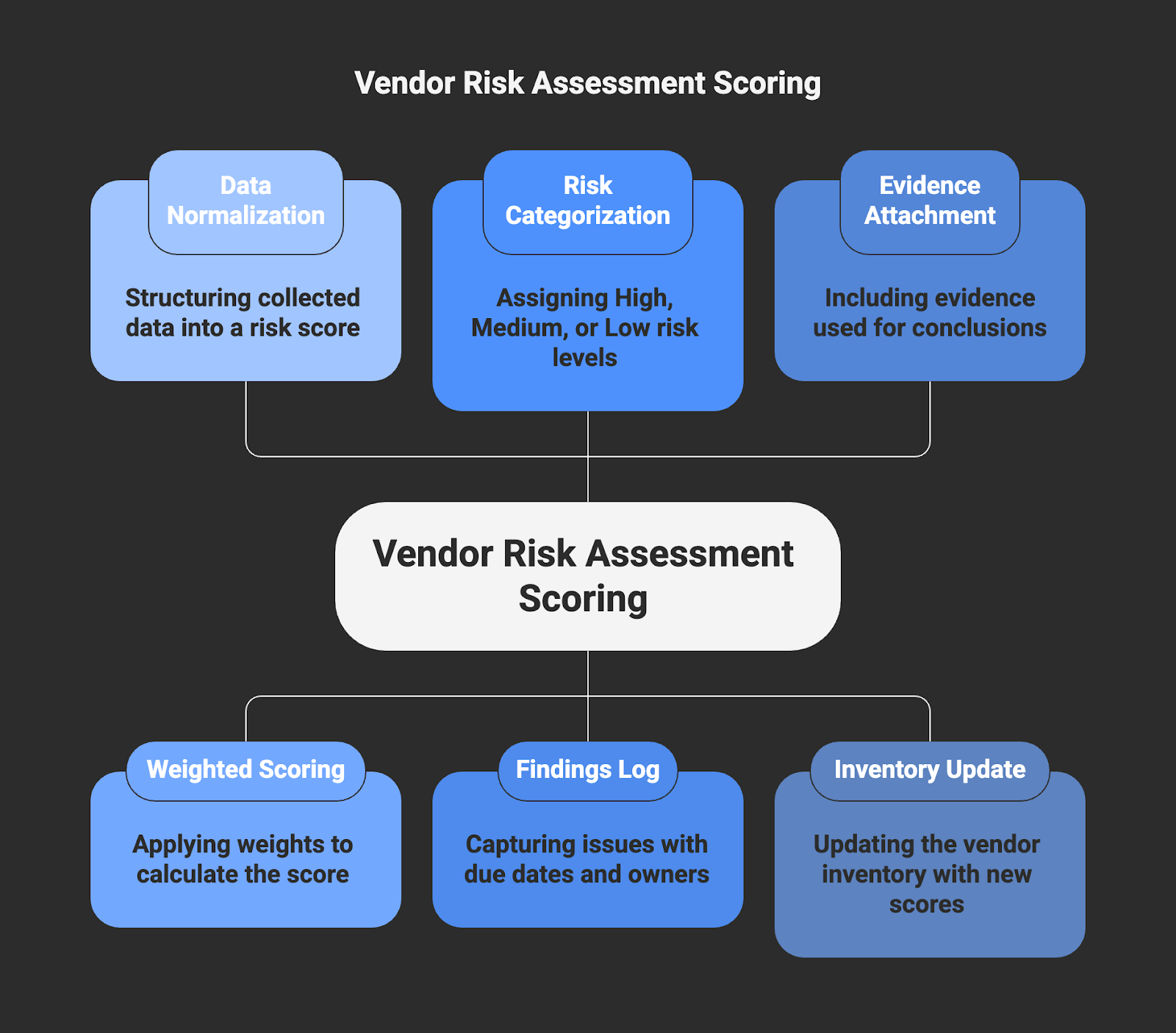
Normalize all of the vendor risk assessment data you’ve collected so far into a structured risk score for each vendor. The score provides leaders with a concise view of the vendor’s posture and a clear prioritization of next steps.
How to do it:
- Apply weights and calculate the score.
- Assign High, Medium, or Low residual risk. Add more categories if you need more granularity.
- Capture issues in a findings log with due dates and owners.
- Attach the evidence used to reach the conclusion.
- Update the vendor inventory with the new score.
Step 7: Create Treatment Plans and Track Remediation
Turn the findings into a set of targeted actions that make the vendor relationship safer. At this stage, the vendor risk assessment transitions from analysis to actual risk reduction.
To manage remediation:
- Convert findings into actions with clear exit criteria.
- Track progress until closure. Escalate overdue items based on their business impact, and assign an executive owner if the issue persists.
- Record any accepted risks with justification and review dates.
- Maintain a simple tracker that business owners can follow.
Step 8: Embed Controls in Contracts and the Vendor Lifecycle
Carry the results of the vendor risk assessment into the contract so controls are part of the agreement. Making the controls part of the agreement gives you enforceable terms instead of informal agreements.
To embed controls:
- Match contract requirements to the vendor’s tier so obligations reflect real risk.
- Add terms for audit rights, breach notification timing, and subcontractor disclosure.
- Include data return or deletion requirements, recovery objectives, and confidentiality language.
- Apply these terms during contract renewal if they weren’t included at onboarding.
Step 9: Continuous Monitoring and Periodic Reassessment
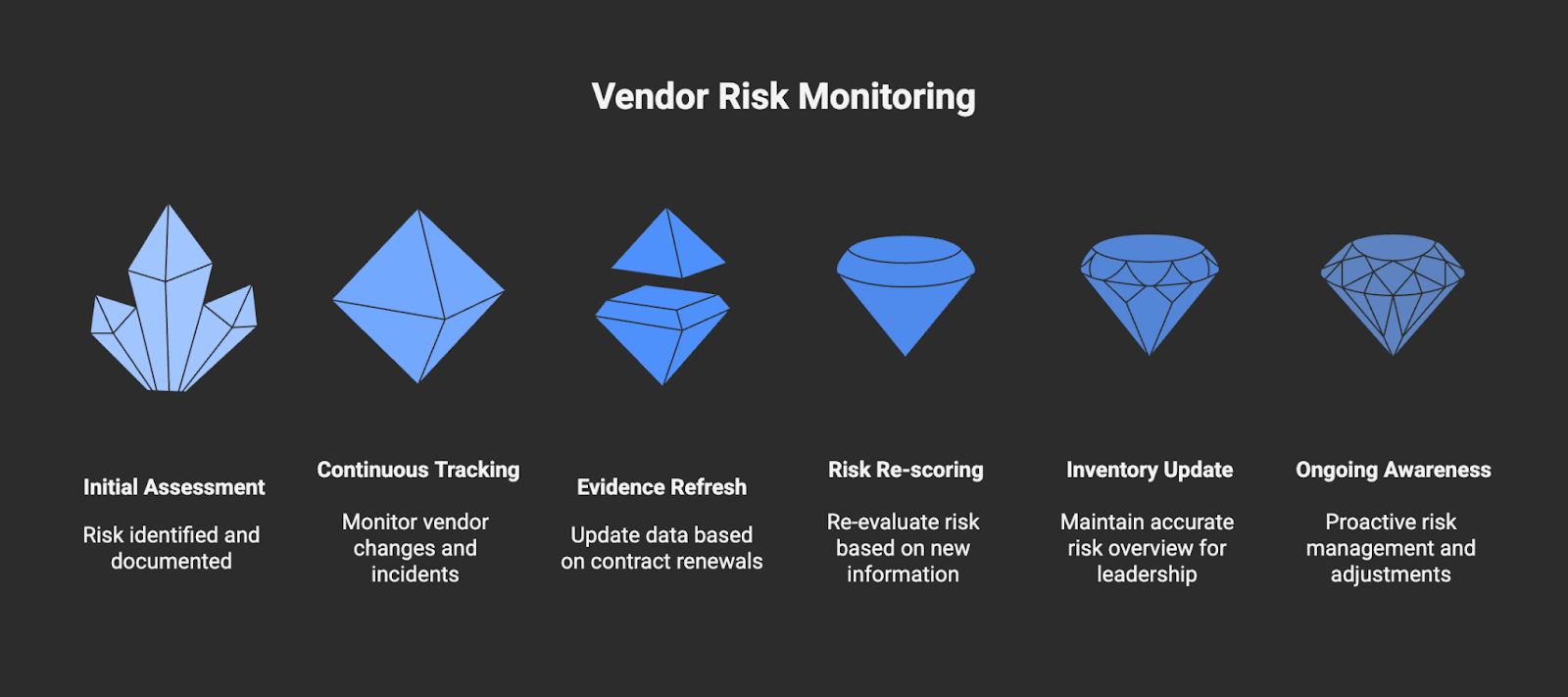
Stay aware of shifts in how the vendor operates, because those changes can affect exposure. Between vendor risk assessments, continuous monitoring provides visibility, allowing you to make adjustments at the right time.
To monitor and reassess:
- Track public incidents, major architecture changes, new regions, ownership shifts, and updates to subcontractors.
- Refresh evidence based on contract renewal dates in your tracker.
- Re-score the vendor when circumstances change in a way that affects exposure.
- Update the inventory so leadership sees an accurate picture of current risk.
Get an Effective, Ongoing Vendor Risk Program with Vistrada
A structured vendor risk assessment provides mid-market teams with a clearer view of their exposure and a reliable method for comparing providers. Once the workflow is consistent and the evidence is organized, vendor oversight becomes predictable rather than a scramble before contract renewals or audits. What most organizations lack is steady ownership that keeps evidence current and drives remediation to closure.
Vistrada delivers a full vendor risk assessment lifecycle as an ongoing service through a team-based vCISO and TPRM model with CIO and CTO access. The team maintains vendor inventory and evidence, and converts assessments into risk scores with clear next steps. Controls move into contract language at renewal, and leaders track posture and progress in an executive dashboard. The result is a vendor risk program that operates predictably and withstands scrutiny from customers and audits.
Contact Vistrada today to learn how we can tailor our risk management solutions to meet the unique needs of your business.